
The Port of Barcelona consolidates annual revenues of over €200 million and starts a heavy investment cycle
At the end of 2025 all the major projects announced were put out to tender (€332.5 million) and this year nine major actions are planned for an amount of €338.7 million.
The import containers and bulk liquid traffic segments closed 2025 at all-time highs.
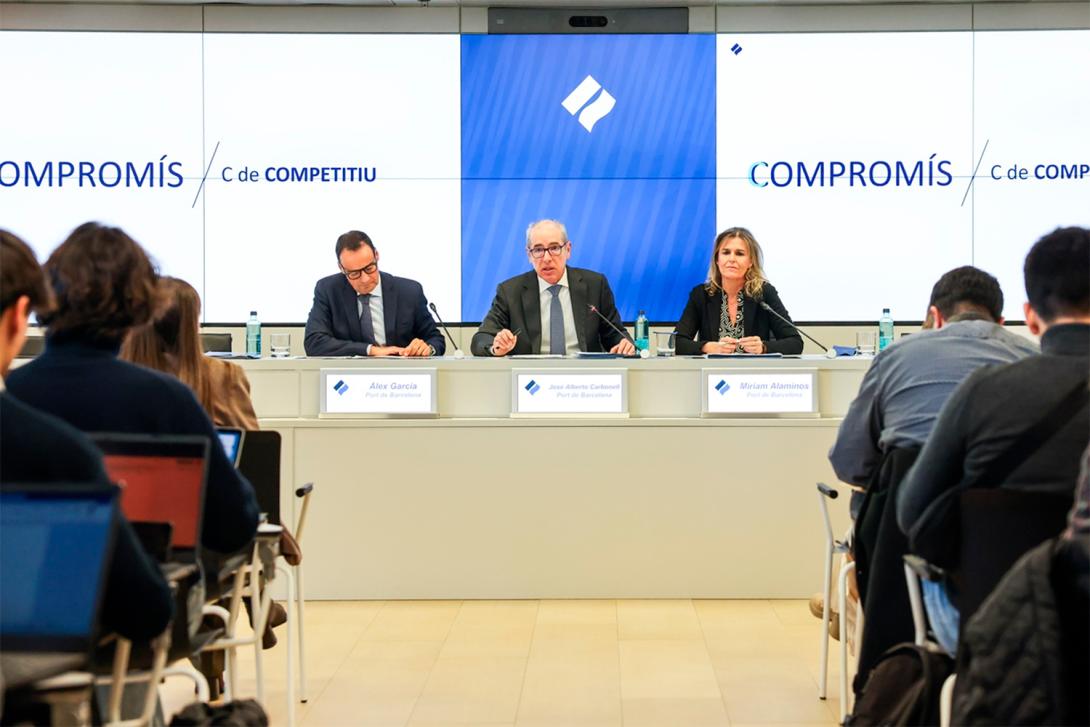
The Port of Barcelona closed 2025 with a turnover of €206 million, up 3% compared to 2024. For the second year running, this growth consolidates a turnover in excess of €200 million, generated mainly by concession fees (€96 million), which are the most stable because of their real estate component; and usage fees (€97 million), related to traffic and port activity.
This year, operating profit (€47 million) fell by 6% due to the extraordinary impact of the financing operation for Barcelona International Terminal (BIT), the new coffee terminal.
As announced last December, the Port of Barcelona is paying 10 million of the total 30 million investment to build this terminal. This project responds to the need to relocate the BIT coffee terminal to expand the vegetable protein plant of the agro-industrial company Elian, representing an investment of €200 million and positioning Barcelona as a key logistics hub for the European agri-food industry. Without this extraordinary impact, operating profit would have been €57 million (+14%).
The Port of Barcelona's contributions to the state port system amounted to €14.6 million. Barcelona is therefore the main contributor to the system once again, providing 45% more than the second contributing port. If we add this figure to the €9 million that the Port of Barcelona will pay in Corporate Tax in 2025, the total contribution to the State coffers exceeds €23 million, equivalent to 11% of turnover.
Bank debt fell by €18 million in 2025 and currently stands at €88 million, with a 4% ratio on the Port Authority's own funds. This figure, along with a business cash flow of €114 million and a cash balance of €365 million, place the Port of Barcelona “in a sound financial position”, explained Miriam Alaminos, Deputy General Director of Finance, Corporate Management and Strategy of the Port of Barcelona, during the entity's results press conference.
100% of announced tenders
From an economic point of view, this is a good starting point for the new heavy investment cycle begun by the Port of Barcelona. Port president José Alberto Carbonell explained that the year 2025 at the Port of Barcelona can be summed up “with our commitment to the economy and the environment, to innovation and the city and, above all, our commitment to people, since in 2025 we laid the foundations to strengthen the Port as a strategic logistics node in the Mediterranean and to deploy projects in the coming years to expand capacities and modernise infrastructures, decarbonise activities and support the growth of companies.” Nonetheless, these projects will require a significant volume of public investment. As an example of this commitment, Carbonell cited “the fulfilment of what we announced at the beginning of last year: the start of a heavy investment cycle that would lead us to tender out seven major projects for €332.5 million by the end of 2025. Not only did we close the year tendering out 100% of the projects, but we also managed to award five out of seven contracts. And we will award the remaining two projects in the coming months.”
The Port of Barcelona plans to maintain this fast rate of tenders in the current financial year. “This year, we are kicking off nine major projects for an amount of €338.7 million,” announced José Alberto Carbonell. These are port infrastructure projects (phase 2 of the enclosures to build the Catalunya wharf, refurbishing the Ponent Nord wharf and reinforcing the North entry mouth seawall to guarantee the safety of the infrastructure and its adaptation to new climatic conditions); road accessibility (construction of the northern junction of the new accesses to the southern enlargement, extending road access to the Adossat wharf with the splitting of the Porta d'Europa bridge and developing accessibility to the new Terminal G for cruise ships); intermodality (track superstructure of the new accesses in the Nou Llobregat area, expanding railway capacity with the doubling of the access road on Carrer 4 and restructuring the railway terminals of the Contradic wharf), and port-city (construction of the Port Center on the ground floor of the Portal de la Pau building).
Traffic segments in 2025
The Port of Barcelona closed 2025 with total freight traffic of 69.5 million tonnes, a very similar figure to 2024 (69.7 million tonnes handled). “If we look at traffic types, while total containers (3.7 million TEUs) was 4.2% lower than in 2024, full import and export containers, which provide the highest added value, closed the year with increases of 4% and 3% respectively. Imports closed 2025 at an all-time high” explained Àlex Garcia, Port of Barcelona General Manager.
Once again this year, China, the US and Turkey are the Port of Barcelona's main trading partners for containerised goods, with market shares of 28%, 6% and 5% respectively.
Liquid bulk traffic ended 2025 at another all-time high, with 16.6 million tonnes handled, representing a growth of 21.7%, thanks to the big increase in imports and transits of gasoline and LNG imports.
At nearly 4.1 million tonnes, dry bulk traffic ended the year down 15% year-on-year, due mainly to a decrease in the arrival of soybeans due to technical shutdowns at one of the treatment plants, and the historically low cement traffic caused by competition from producers in third countries with laxer environmental regulations.
Ro-ro traffic was 430,406 UTIs (+0.6%) with growth in traffic with the Balearic Islands and decreases in services with Italy.
New car shipments increased 5.1%, with a total of 716,657 units handled. There was a significant increase in imports, to the tune of 44%. Electric vehicles now represent nearly 12% of the total number of new vehicles passing through the Port of Barcelona, with an increase of 75.7% compared to the previous year.
There were 5.8 million passenger movements (+7.3%), of which 1.8 million correspond to ferry passengers. Turning to cruise traffic, the number of passengers embarking and disembarking in Barcelona - who bring the most value to the city - continues to grow, with the base port share reaching 58%. This places the number of cruise ship passengers visiting the city at 2.3 million people (+7.6%).
Presentation of results 2025


Informative and corporate video about the results of the Port of Barcelona for the year 2025, published on the official Port of Barcelona channel. The visual content shows dynamic images of the Port of Barcelona, merchant vessels, container terminals, port cranes, and loading and unloading operations, with a professional style and fast pace. The video highlights the cargo traffic figures of the port during the 2025 fiscal year, valuing its position as the main logistics hub in the Mediterranean. Visually, graphics, infographics, or texts illustrating traffic evolution, growth compared to previous years, and the different types of goods transported can be seen. Images of port infrastructure, large-tonnage vessels, and daily logistics activity are also included. The tone is corporate, informative, and celebratory of the achieved results, with possible voice-over narration and background music. The content values the Port of Barcelona's capacity to generate prosperity, connect Barcelona with the world, and continue leading the competitiveness of the logistics and maritime sector.


