
The approval of the Intermodal Logistics Terminal Urban Master Plan green-lights the construction of the Port of Barcelona's south railway node
Building this railway junction will require an investment of approximately €265 million.
The Port of Barcelona will invest €26 million to create green areas in compliance with the Plan.
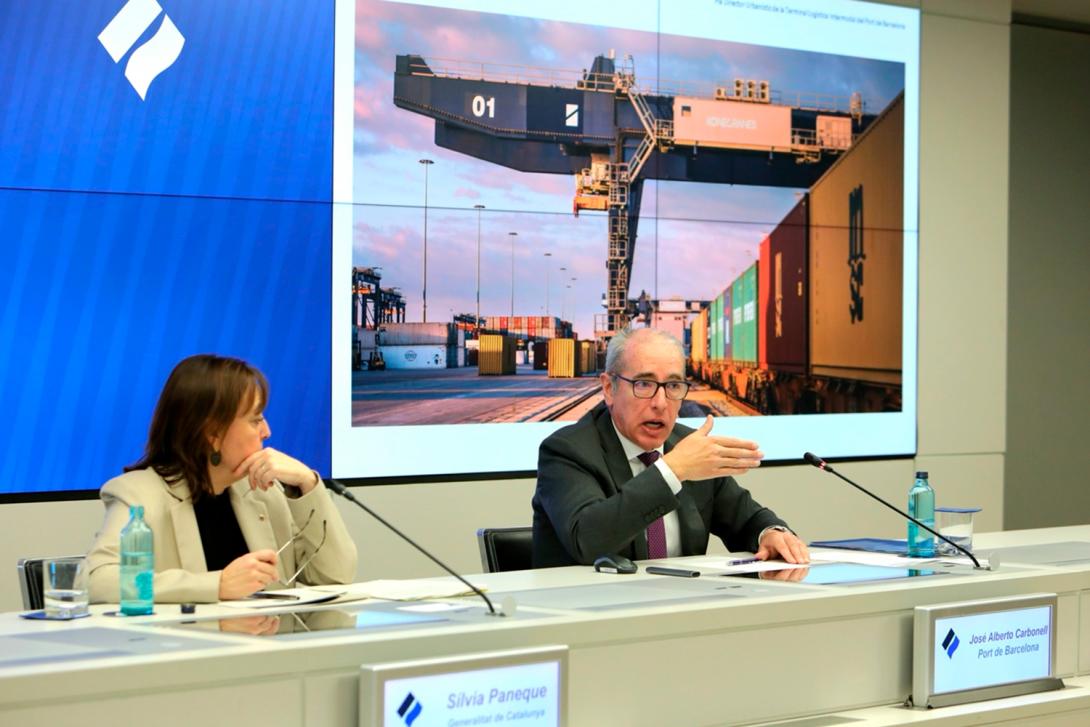
Today the Territorial Commission of Catalonia approved the Intermodal Logistics Terminal of the Port of Barcelona Urban Master Plan (PDU by its Catalan initials), a document that organises the development of the railway infrastructure in the south area of the Port. This railway node comprises a group of infrastructures, including: a rolling road terminal, a reception and dispatch terminal and a loading and unloading terminal, all located on the former bed of the Llobregat River, as well as a reception and dispatch terminal parallel to the current course of the river and known as Terminal Nou Llobregat. This is a supramunicipal infrastructure, developed thanks to the Port reaching a consensus with the city councils of Barcelona and El Prat, and also involving the Government of Catalonia and Barcelona Regional.
In practice, the approval of the PDU green-lights the construction of the Port of Barcelona south railway node, which will facilitate the transfer of large volumes of goods from road to rail and will substantially cut the emissions produced by logistics chains and other negative externalities, such as road congestion and accidents. Building this railway junction will require an investment of approximately €265 million, 70 million of which correspond to the Nou Llobregat Terminal, located parallel to the new Llobregat riverbed and already under construction; 150 million correspond to the future terminals of the old riverbed; and €45 million will be earmarked to complementary works that will provide service to the entire infrastructure. In compliance with the PDU, the Port of Barcelona will invest €26 million to create green areas.
The approval granted today by the Territorial Commission of Catalonia marks the end of a lengthy dialogue and negotiation process involving four years of procedures, including a citizens participatory process, environmental formalities and public information, and means the necessary actions to build the railway node can now commence.
The Port of Barcelona is fostering rail transport because it is both efficient and competitive. This Port strategy has removed the need for more than 1.7 million truck journeys over the last ten years. In 2024, rail traffic in the port area totalled 11,000 movements, meaning the removal of 155,000 trucks from the road transport mode. Replacing this road traffic avoided 48,500 tonnes of CO2 emissions, equivalent to planting 291,000 trees.
A powerful railway node with six terminals
The PDU infrastructures, together with others nearby, such as the Prat wharf loading and unloading railway terminal and Terminal C for reception and dispatch, which are already up and running, will constitute a very powerful railway node, with six terminals, which will serve the Port of Barcelona and its surrounding area: the Barcelona Zona Franca, the Polígon Pratenc, and the industries of Baix Llobregat and the south of Barcelona. This node will serve maritime-terrestrial and terrestrial-maritime traffic, but also terrestrial-terrestrial traffic, which will be able to take advantage of this infrastructure to sustainably and efficiently reach their markets.
The urban planning sector that includes the PDU covers an area of 131 hectares and the railway node is part of the Mediterranean Corridor.
During 2024, rail traffic at the Port of Barcelona was 219,000 TEUs and 295,000 vehicles. This year, counting the accumulated rail traffic to October, the forecast is to end 2025 with a rail share of 12% in containers and 45% in vehicles. Once the six new terminals of the south rail junction are operational, it will be possible to shift about 640,000 containers and 46,000 semi-trailers from road to rail mode annually.
New public green áreas
The PDU includes the regulation and urban planning of the spaces affected by the new infrastructures. One of the most significant aspects is that the Port of Barcelona will create 24 hectares of new public green areas, comprising the Llobregat Agricultural Park-Montjuïc Park Green Corridor, a network of itineraries that will connect the various port logistics areas and natural spaces.
“The Intermodal Logistics Terminal PDU integrates the infrastructures through landscaping using green corridors that act as a cushion, while improving the connection between urban centres and areas of economic activity and guaranteeing the environmental and social function of the new public spaces to be generated. Therefore the Port of Barcelona Intermodal Logistics Terminal will not affect the valuable surrounding areas", explains José Alberto Carbonell, President of the Port of Barcelona.
“The Port of Barcelona Intermodal Logistics Terminal Urban Master Plan is the driving force behind a broader project: transforming our Port into a future touchstone in the Mediterranean, able to adapt to the new economic, environmental and logistical needs of the 21st century. Our commitment to updating and modernising the Port of Barcelona is a transformation brought about with profound respect for the identity of Catalonia and Barcelona, as territories that are pioneers in terms of modernity and openness, commerce and new technologies”, says Sílvia Paneque, Regional Minister for Territory, Housing and Ecological Transition.
The green areas planned within the PDU will form a network of structuring axes and freely accessible areas within the municipal areas of Barcelona and El Prat de Llobregat. There are six different actions: perimeter walkway at the ZAL Barcelona; perimeter walkway at the ZAL Prat; ZAL-Pratenc park; perimeter walkway in the Polígon Pratenc Industrial Estate; river space and green connection node; Ricarda park, and park on the Bunyola road. The investment will guarantee the environmental and social function of the public spaces and will be shared between the Port of Barcelona and Cilsa, the company that manages the ZAL.


