
The Port of Barcelona's Energy Transition Plan will enable an 85% reduction in CO2 emissions by 2040
The Plan unveiled today will halve emissions by 2030, reducing emissions by one million tonnes compared to 2017.
Investments at the Port of Barcelona related to infrastructure for the energy transition total €1.7 billion.
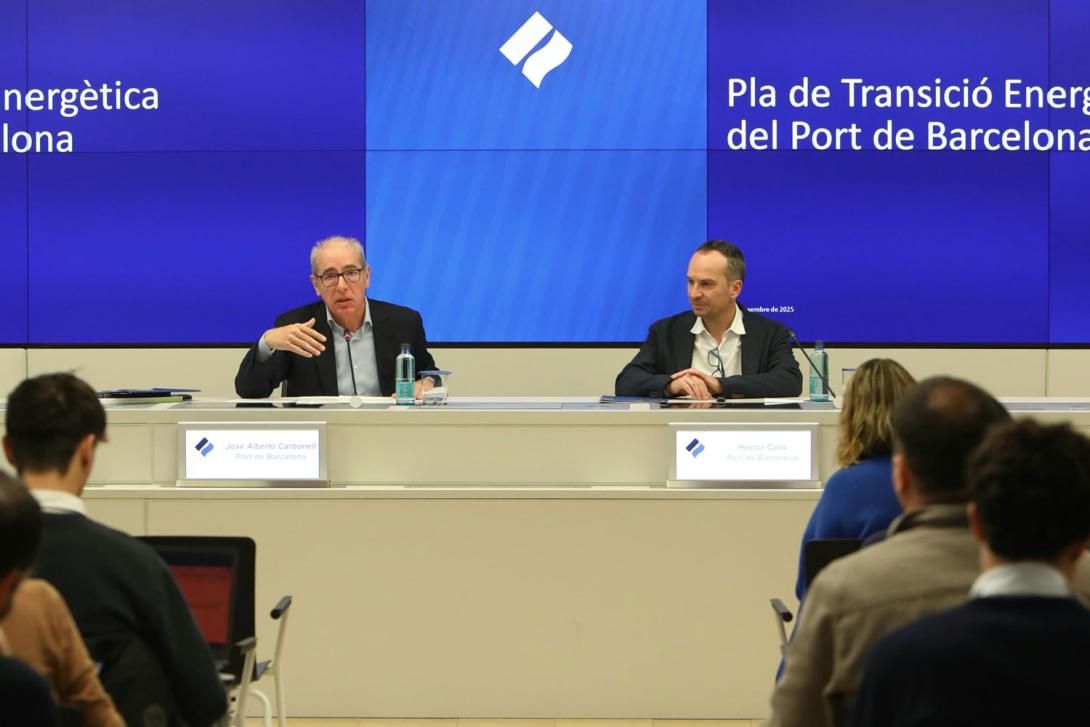
The Port of Barcelona has approved its Energy Transition Plan, a document derived from the Fourth Strategic Plan, which will set the port's energy policy until 2040, establishing the objective of reducing greenhouse gas emissions by 85% in 2040 compared to 2017, and sets the path to becoming an emissions-neutral port by 2050.
The Energy Transition Plan encompasses all the measures that the Port of Barcelona is undertaking to decarbonize port activity, guarantee the supply of sustainable energy, both environmentally and economically, and become a leading centre for energy activities. As its most immediate goal, the document sets out to halve emissions in 2030 compared to 2017 levels, which will mean reducing the emissions generated by one million tonnes in the period 2025 - 2030. This is equivalent to the annual emissions of 240,000 cars.
However, the Energy Transition Plan goes further than simply setting emission reduction targets to fight against climate change. With this Plan, the Port of Barcelona will no longer treat energy as a commodity but as a strategic factor key to bolstering the competitiveness of the port and the surrounding area in an increasingly demanding global market. This transformation will simultaneously consolidate the Port of Barcelona's leadership in both the maritime and port sectors and in the entire logistics chain, promoting the energy transition far beyond the port area.
Specific actions and objectives
In this connection, the document includes an Action Plan with over 150 actions, grouped into four main areas: decarbonising port activity; sustainability of energy consumption; resilience to guarantee energy supply and innovation to facilitate the emergence of new business models; and the adoption of emerging technologies.
This Action Plan includes specific measures to foster energy efficiency, setting the goal that in 2030, 50% of port activity will be electrified and 65% of container ship and cruise ship calls will be connected to OPS systems, allowing them to turn off their engines while in port, a figure that will increase to 90% by 2050.
The focus is also on local energy production, aiming to have 100 MWp of photovoltaic energy installed by 2030 and exploring formulas that allow for strategic management. However, production will not be limited to solar energy, as there are also plans to produce 100,000 tonnes of sustainable fuels per year - biomethane and synthetic fuels. These fuels are key to decarbonising maritime transport; being able to supply them allows us to be part of maritime green corridors and attract the most efficient and sustainable ships.
The Energy Transition Plan also impacts innovation, in both technologies and business models. Developing the hydrogen economy is one example, with the connection of the H2MED gas pipeline representing a great opportunity to make the Port of Barcelona a hub for this sustainable fuel. Nonetheless, the Plan also foresees other technologies such as CO2 capture systems and their subsequent use, through the circular economy, for producing synthetic fuels, among other elements.
A shared goal
The energy transition is a joint effort of Barcelona Port Community, therefore the Energy Transition Plan must allow all companies and organisations present in the port to align themselves around a common goal: to transform the port into a sustainable energies hub to lead the decarbonisation of the logistics chain. To enable this, planned investments in infrastructure total around €920 million in private funds and €780M in public funds.
“The Energy Transition Plan marks port planning for the coming years and will transform our energy model, generating new business areas. All the actions currently underway, and those still to be carried out at the Port of Barcelona, have been designed and conceived with the energy transition in mind. Sustainability already permeates the entire port business,” assured its president, José Alberto Carbonell, when the document was unveiled. In this connection, he recalled that “the Port has a key role in the energy sector and must act as a strategic node that not only imports, stores and distributes, but also produces and ensures the supply of different sustainable energies.”
“The Energy Transition Plan outlines the roadmap to guarantee competitiveness for the Port of Barcelona and protect the well-being of future generations while preserving our environment,” said Hector Calls, director of Environmental Sustainability and Energy Transition, adding that “it positions the Port as a benchmark in sustainability, energy innovation and a model of resilience on a Mediterranean and European scale.” This Plan is a dynamic, flexible document that will incorporate any technological and regulatory changes developed over the coming years and includes certified calculation methods to guarantee compliance with the planned milestones. To this end, indicators will be published annually to ensure transparency and quantify progress towards the established objectives; periodic reviews will be made to fine-tune the strategy, while new solutions, regulations and events that affect the initial approaches will be monitored.


Corporate video by the Port of Barcelona (1 min 48 s) presenting its Energy Transition Plan, with a Catalan voice-over (subtitled) and sweeping aerial shots of the port. It opens with the Port's logo on a black background and dawn footage of Montjuïc, the container terminal and gantry cranes hoisting containers, over which the title "Pla de Transició Energètica" appears. The video combines b-roll —fuel storage tanks, workers in orange overalls among red pipes and valves, the Port Vell with traditional boats, and warehouse roofs covered with solar panels— with animated graphic captions and icons that lay out the plan's pillars and targets: Decarbonisation, Sustainability, Resilience and Innovation. Over the aerial views of the container terminal, data graphics show the greenhouse-gas (GHG) emissions-reduction milestones: −50% by 2030, −85% by 2040 and a "Port Neutre" (net-zero emissions) by 2050. Further targets are illustrated with matching footage: 65% (2030) and 90% (2050) of container-ship and cruise calls connected to onshore power supply (OPS); 50% of port activity electrified by 2030; new rail accesses and terminals; local generation of 100 MWp of photovoltaic energy; production of 100,000 tonnes of sustainable fuel; green maritime corridors (with an LNG vessel and a cruise ship); clean fuels made from CO₂; a hub for new fuels; and €1,700M of public-private investment. The video closes with dawn shots of the port and the harbour-mouth lighthouse, and the Port of Barcelona logo.


