.
The Port of Barcelona seeks economic growth that is sustainable over time, minimises externalities and guarantees development in social and environmental aspects. This development depends on the dynamism of goods traffic, passenger transport and logistics and related activities and not only impacts the Port area per se, but also wealth creation in the hinterland.


This chapter presents two types of information and data:
On the activity of the organisations that manage goods and passenger transport at the Port of Barcelona, which are drawn from the data control systems of Barcelona Port Authority (APB) and reported monthly on the corporate website in “Port of Barcelona Traffic Statistics”..
On the financial year, which refer to the results of APB as the organisation responsible for managing the Port of Barcelona and are significant for the whole because 1) the APB's revenue comes from aggregated port activity and 2) the resources generated are invested in port infrastructure, the commercial promotion and strategy of the Port and its Community, and management.
Specialising in high-value goods, the Port of Barcelona is one of the main drivers of economic development in Catalonia and Spain. In value terms, it channelled 70% of the maritime external trade of Catalonia and 24% of the total for Spain in 2024. In 2024 the approximate value of the total goods that passed through the Port was €113.343 billion, a figure almost identical to that of 2023 and which maintains Barcelona as the number one port in Spain in terms of the value of external import and export trade passing through it.
Value of goods passing through the Port of Barcelona (billion EUR), 2020-2024
| 2020 | 2021 | 2022 | 2023 | 2024 |
|---|---|---|---|---|
| 68.739 | 88.869 | 120.686 | 113.118 | 113.343 (+0,2%) |
The Port of Barcelona's market share in the hinterland –the percentage of trade flows of a region routed through it– makes it possible to understand its positioning within Spain.
In terms of Catalonia's total external trade in value terms, in 2024, the Port of Barcelona:
In terms of Spain's total external trade in value terms, in 2024, the Port of Barcelona:
| 2020 | 2021 | 2022 | 2023 | 2024 | |
|---|---|---|---|---|---|
| Market share of Catalonia's maritime external trade - bulk and general cargo (%), 2020-2024 |
% |
% |
% |
% |
% |
| Market share of Catalonia's maritime external trade - containers (%), 2020-2024 |
% |
% |
% |
% |
% |
| Market share of Spain's maritime external trade - bulk and general cargo (%), 2020-2024 |
% |
% |
% |
% |
% |
| Market share of Spain's maritime external trade - containers (%), 2020-2024 |
% |
% |
% |
% |
% |
Catalonia is the leading importing and exporting region in Spain, with a widely diversified external trade sector. The main economic sectors of Catalan maritime external trade and their business and industrial fabric use the Port of Barcelona principally to channel their trade flows. The Port helps to make the economy more competitive by providing an infrastructure tailored to needs, and by providing efficient and specialised services.
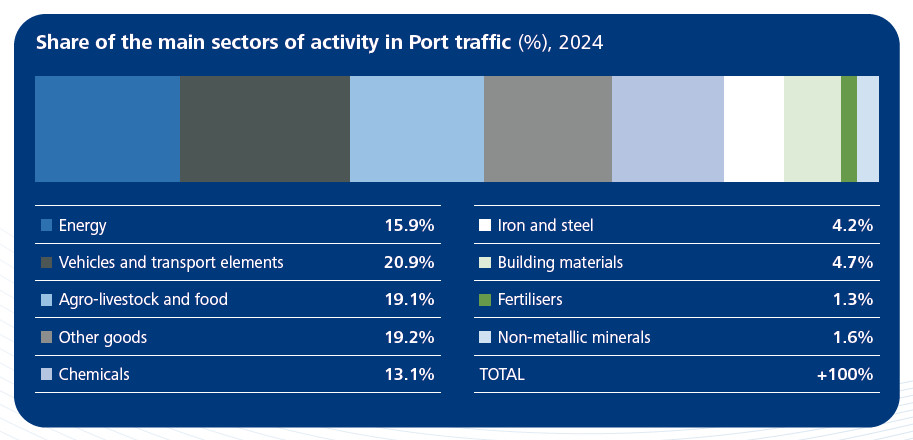
Most sectors of activity reported increases in port traffic. The vehicles and transport elements sector is now the leader in total volume of traffic in tonnes.
| Sectors | 2020 | 2021 | 2022 | 2023* | 2024 | Variation % 2023/24 |
|---|---|---|---|---|---|---|
| Energy | 11,134,280 | 10,591,889 | 14,098,609 | 11,146,205 | 10,764,019 | -3.4% |
| Vehicles and transport elements | 11,002,575 | 12,803,453 | 13,392,295 | 13,017,592 | 14,176,642 | 8.9% |
| Agro-livestock and food | 12,474,665 | 14,121,246 | 13,775,887 | 13,147,115 | 12,950,205 | -1.5% |
| Other goods | 10,611,026 | 12,733,386 | 12,911,197 | 11,774,445 | 13,008,792 | 10.5% |
| Chemicals | 6,158,665 | 6,599,982 | 6,775,077 | 6,198,416 | 8,904,603 | 43.7% |
| Iron and steel | 2,786,459 | 3,109,251 | 2,984,478 | 2,780,665 | 2,881,897 | 3.6% |
| Building materials | 3,185,403 | 3,081,275 | 3,170,668 | 2,619,632 | 3,155,231 | 20.4% |
| Fertilisers | 514,962 | 624,890 | 881,199 | 707,232 | 886,131 | 25.3% |
| Non-metallic minerals | 624,576 | 1,228,231 | 1,156,071 | 1,036,724 | 1,103,100 | 6.4% |
| TOTAL | 58,492,611 | 64,896,014 | 69,145,480 | 62,428,027 | 67,830,621 | 8.7% |
*The 2023 data has been readjusted compared to the data published at the end of the previous financial year.
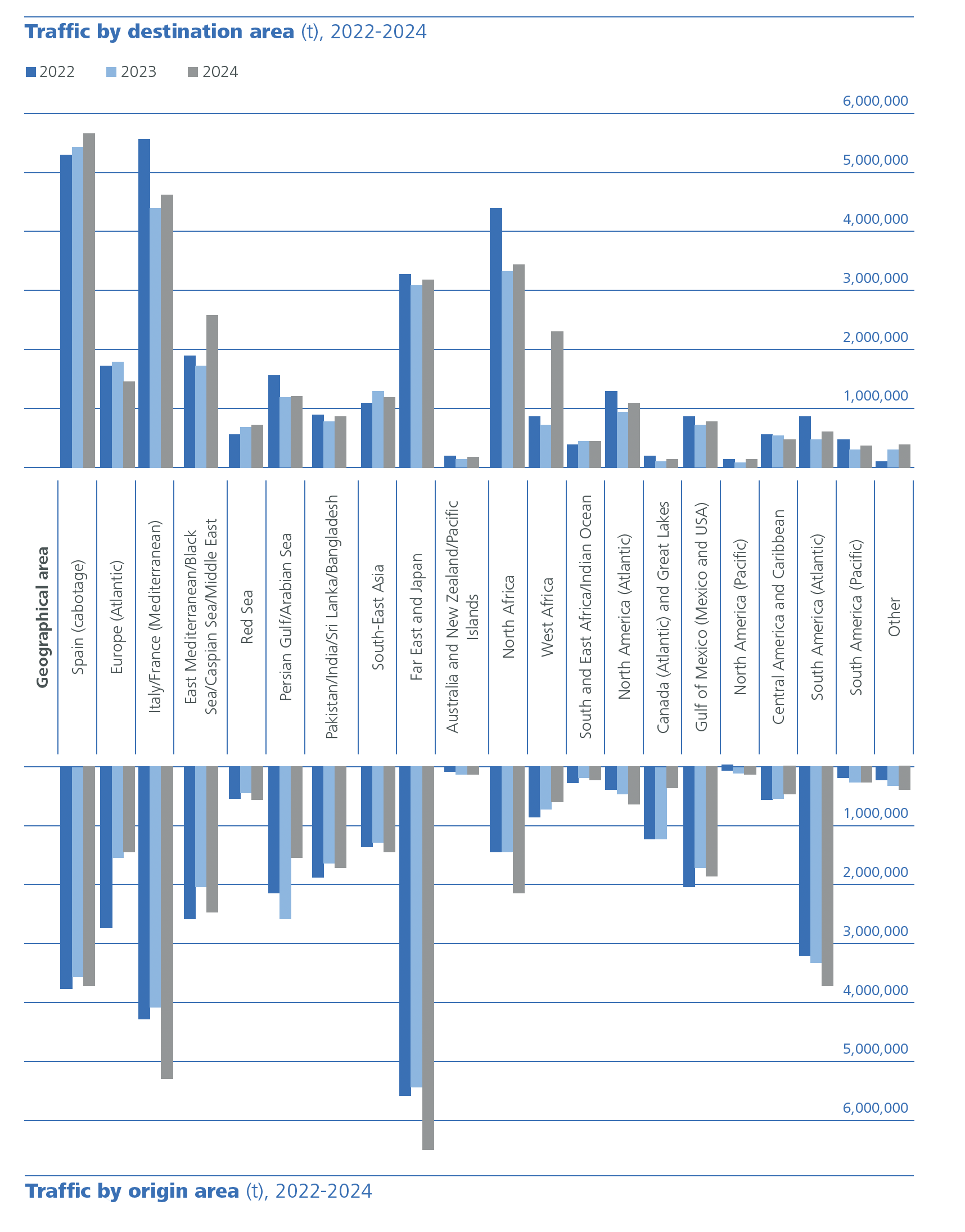
Traffic by geographical area (t), 2023-2024
| Geographical area | 2023 | 2024 | Difference 2024/2023 | Variation % 2024/2023 | 2024 SHARE % of total |
|---|---|---|---|---|---|
| Spain (cabotage) | 8,732,947 | 9,280,099 | 547,152 | 6.3% | 13.7% |
| Europe (Atlantic) | 3,373,031 | 2,909,939 | -463,092 | -13.7% | 4.3% |
| Italy/France (Mediterranean) | 8,428,962 | 9,968,652 | 1,539,690 | 18.3% | 14.7% |
| Eastern Mediterranean/Black Sea/Caspian Sea/Middle East | 4,949,559 | 6,246,520 | 1,296,962 | 26.02% | 9.2% |
| Red Sea | 989,686 | 1,560,424 | 570,738 | 57.7% | 2.3% |
| Persian Gulf/Arabian Sea | 3,685,235 | 2,737,707 | -947,529 | -25.7% | 4.0% |
| Pakistan/India/Sri Lanka/Bangladesh | 2,681,506 | 2,773,009 | 91,502 | 3.4% | 4.1% |
| South-East Asia | 2,524,429 | 2,691,112 | 166,683 | 6.6% | 4.0% |
| Far East and Japan | 8,614,679 | 9,520,592 | 905,913 | 10.5% | 14.0% |
| Australia and New Zealand/Pacific Islands | 217,266 | 247,180 | 29,914 | 13.8% | 0.4% |
| North Africa | 4,750,113 | 5,617,728 | 867,616 | 18.3% | 8.3% |
| West Africa | 1,459,097 | 2,650,883 | 1,191,786 | 81.7% | 3.9% |
| South and East Africa/Indian Ocean | 511,284 | 573,014 | 61,730 | 12.1% | 0.8% |
| North America (Atlantic) | 1,436,842 | 1,668,106 | 231,264 | 16.1% | 2.5% |
| Canada (Atlantic) and Great Lakes | 1,257,140 | 432,370 | -824,770 | -65.6% | 0.6% |
| Gulf of Mexico (Mexico and USA) | 2,631,103 | 2,858,894 | 227,791 | 8.7% | 4.2% |
| North America (Pacific) | 129,570 | 208,586 | 79,016 | 61% | 0.3% |
| Central America and Caribbean | 1,159,204 | 1,100,832 | -58,372 | -5.0% | 1.6% |
| South America (Atlantic) | 3,745,885 | 3,482,010 | -263,875 | -7.0% | 5.1% |
| South America (Pacific) | 570,415 | 591,838 | 21,423 | 3.8% | 0.9% |
| Other | 580,072 | 711,125 | 131,053 | 22.6% | 1.0% |
| Total | 62,428,027 | 67,830,621 | 5,402,594 | 8.7% | 100% |
In 2024 the impact of the Red Sea crisis translated to increased traffic, particularly in transshipment of containerised cargo, with the Port of Barcelona closing the year with total traffic at 69.7 million tonnes (+8.9%) and record volumes of container traffic (3.9 million TEU, +19%).
The growth is explained primarily by containerised cargo (+12%), followed by conventional cargo (+10%) and liquid bulk (+6%), while dry bulk (+0.1%) essentially maintained 2023 figures. All major traffic segments, except for new vehicles (-14%), recorded positive results.
Hinterland traffic rose slightly to reach 42.8 million tonnes (+1%).
Passenger movements (+2%) involved a total of 5.4 million people, a record figure that is 17% above that of 2019. Of these, 3.6 million were cruise passengers, up 14% from pre-COVID-19 pandemic levels.
Total traffic
(million tonnes)
2024: 69.7
2023: 64
v. 2024/2023: +9%
Hinterland traffic
(million tonnes)
2024: 42.8
2023: 41.9
v. 2024/2023: +2%
Containers
(million TEU)
2024: 3.9
2023: 3.2
v. 2024/2023: +19%
Passengers
(million people)
2024: 5.4
2023: 5.3
v. 2024/2023: +2%
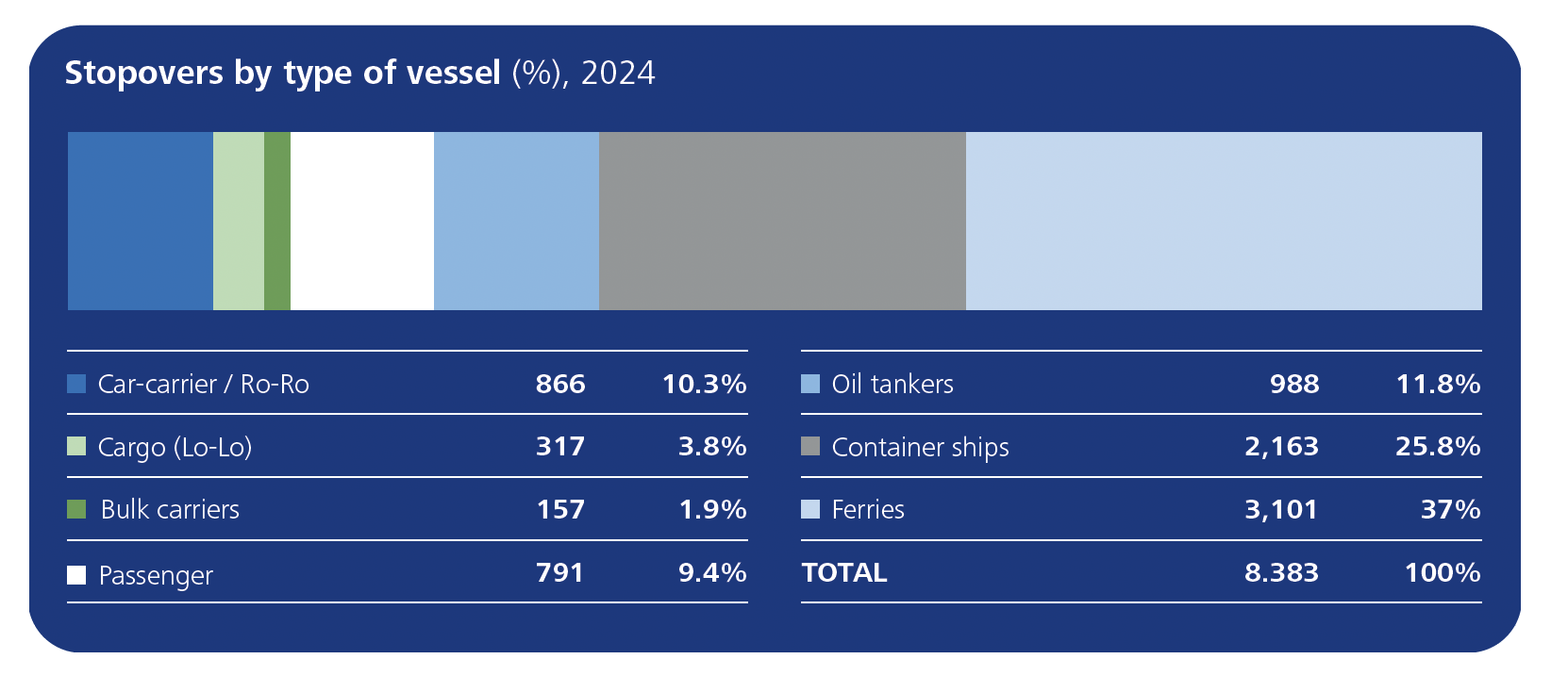
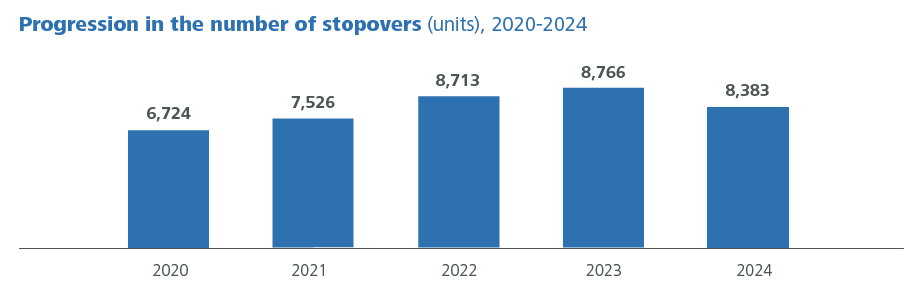
During this year the Port of Barcelona logged a total of 8,383 stopovers, with an average ship tonnage of 43,450 tonnes (+2%).
Characteristics of the Port’s traffic, 2024
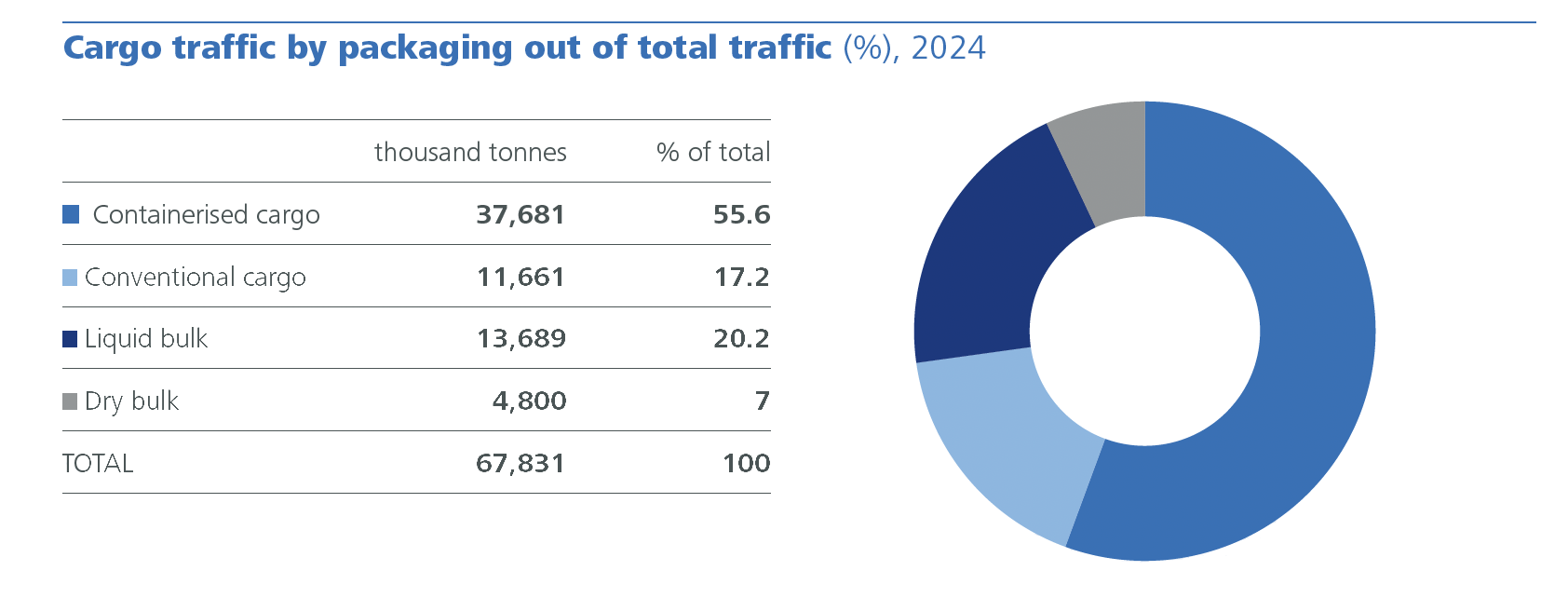
By type of packaging for goods: 56% of the traffic was containerised cargo.
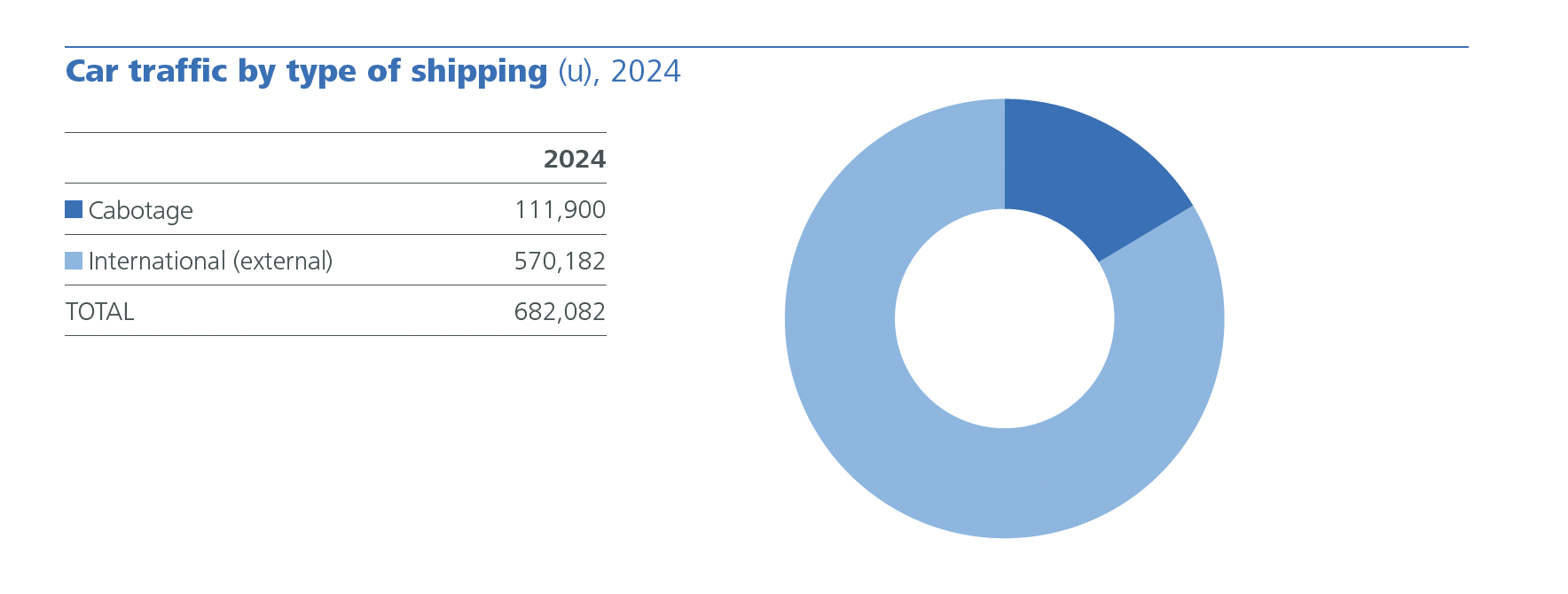
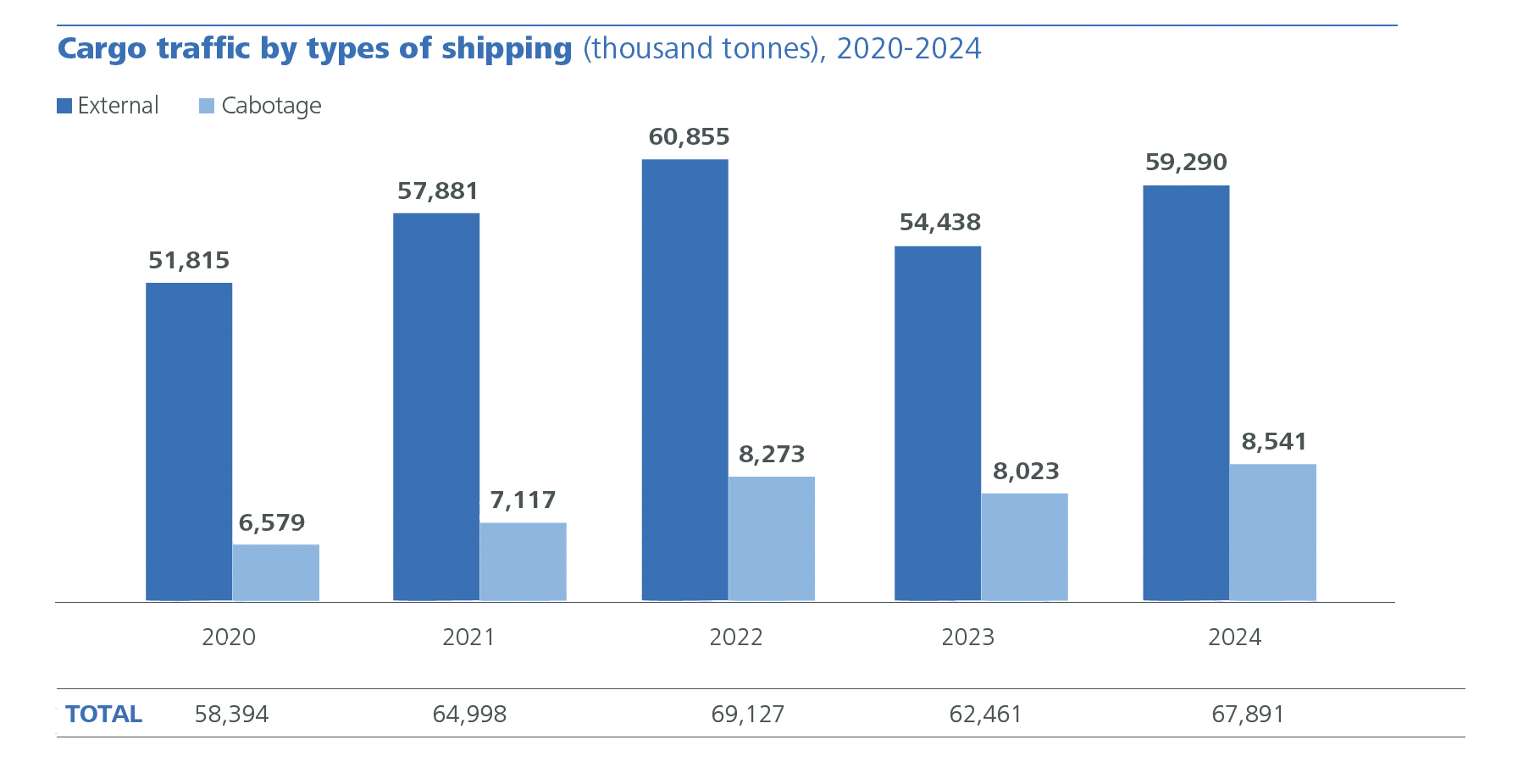
By type of shipping: 87% external traffic and 13% cabotage.
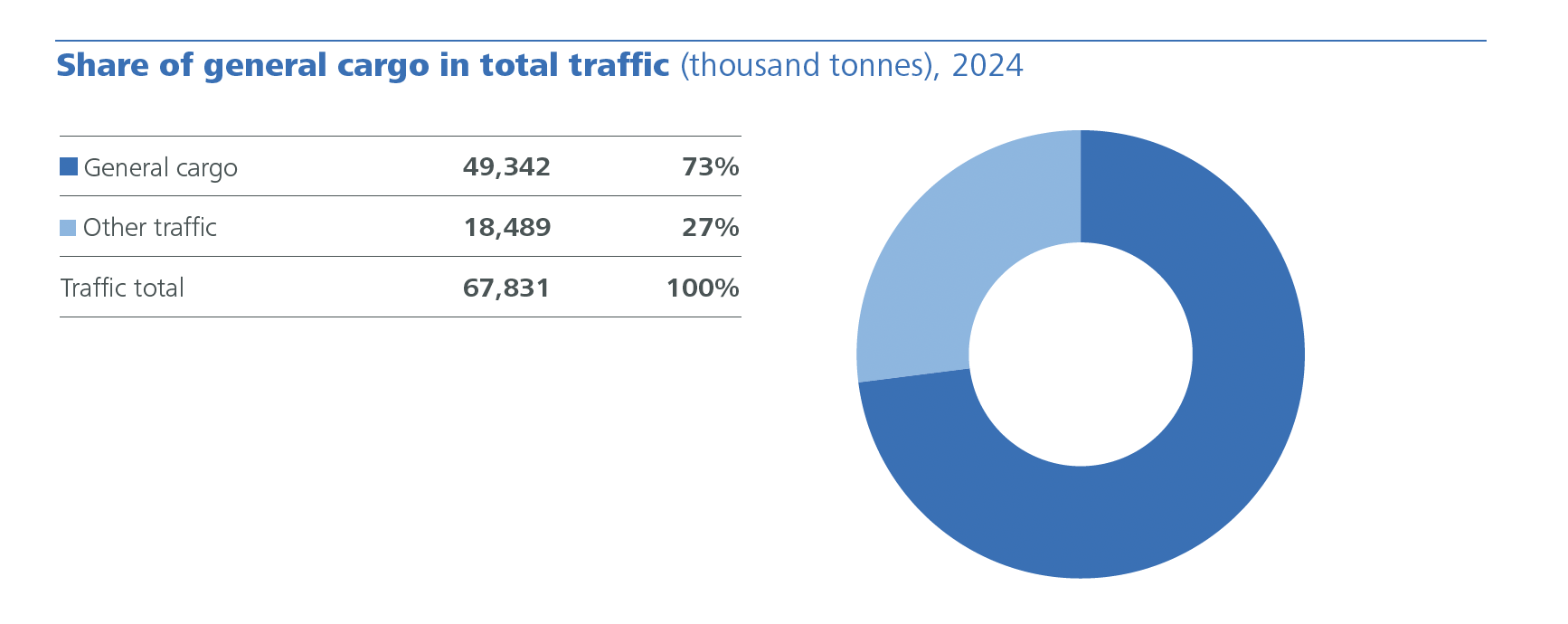
General cargo made up 72.7% of total traffic – more than 49 million tonnes, 37.6 million of them containerised.
Development of cargo traffic* by type of packaging (thousand tonnes), 2020–2024
| Sectors | 2020 | 2021 | 2022 | 2023 | 2024 |
|---|---|---|---|---|---|
| Containerised cargo | 31,980 | 37,455 | 37,610 | 33,525 | 37,681 |
| Conventional cargo | 9,555 | 10,713 | 11,415 | 11,222 | 11,661 |
| Liquid bulk | 12,799 | 12,370 | 15,553 | 12,919 | 13,689 |
| Dry bulk | 4,059 | 4,459 | 4,549 | 4,795 | 4,800 |
| TOTAL | 58,393 | 64,997 | 69,127 | 62,461 | 67,831 |
*Excludes fishing and provisioning, tare weight, etc.
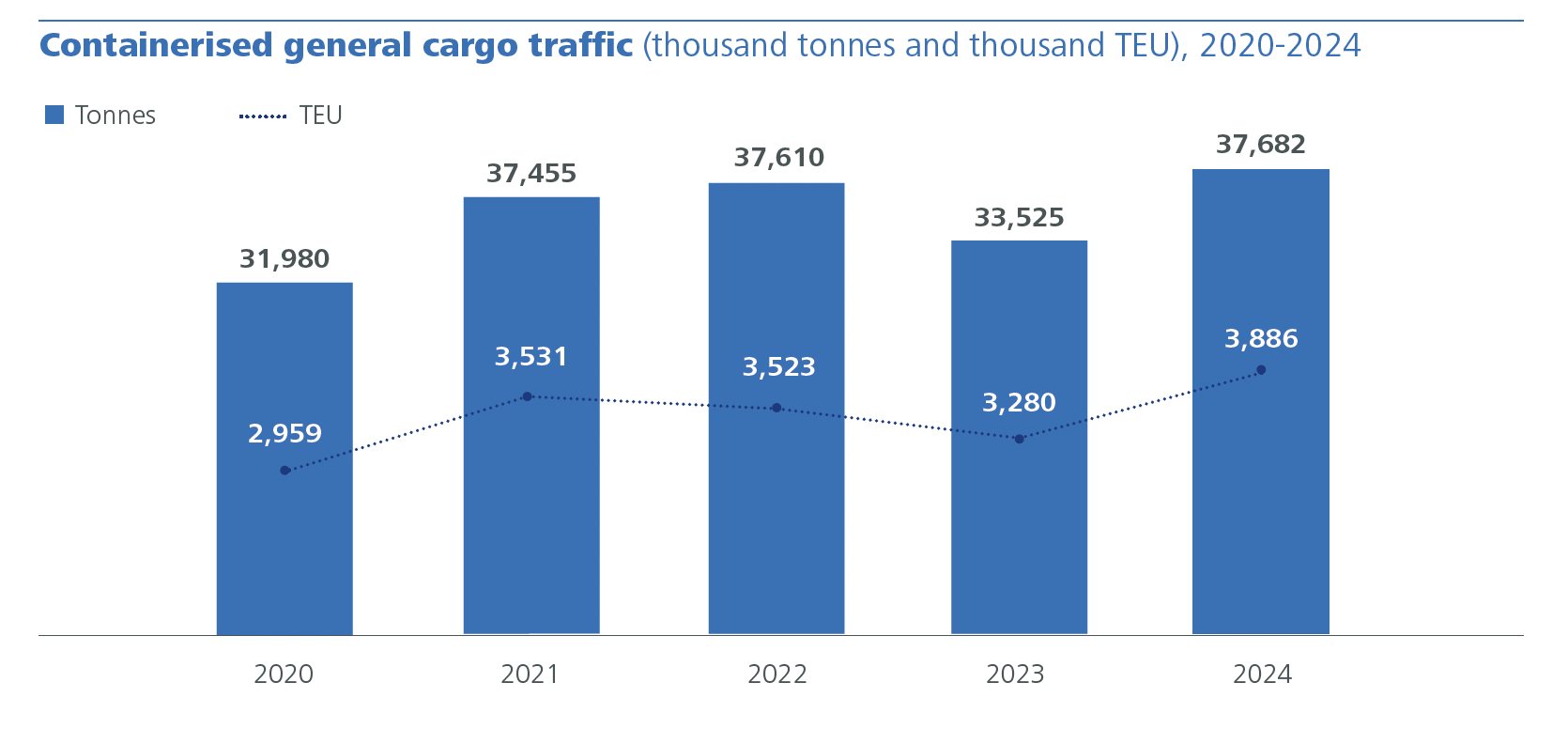
The year 2024 closed with record-breaking volumes of container traffic – 3.9 million TEU (+19%) – due primarily to the increase in transshipment TEU. This was driven by the shift to maritime routes via the Cape of Good Hope, which the world’s major shipping lines had to use as it was impossible to access the Mediterranean via the Suez Canal – a consequence of attacks by Houthi rebels in the Bab el-Mandeb Strait. This rerouting affected the ports of the eastern Mediterranean in particular and, consequently, both the Port of Barcelona and others in the west served as transshipment hubs for the major shipping routes, using smaller vessels to supply affected ports.
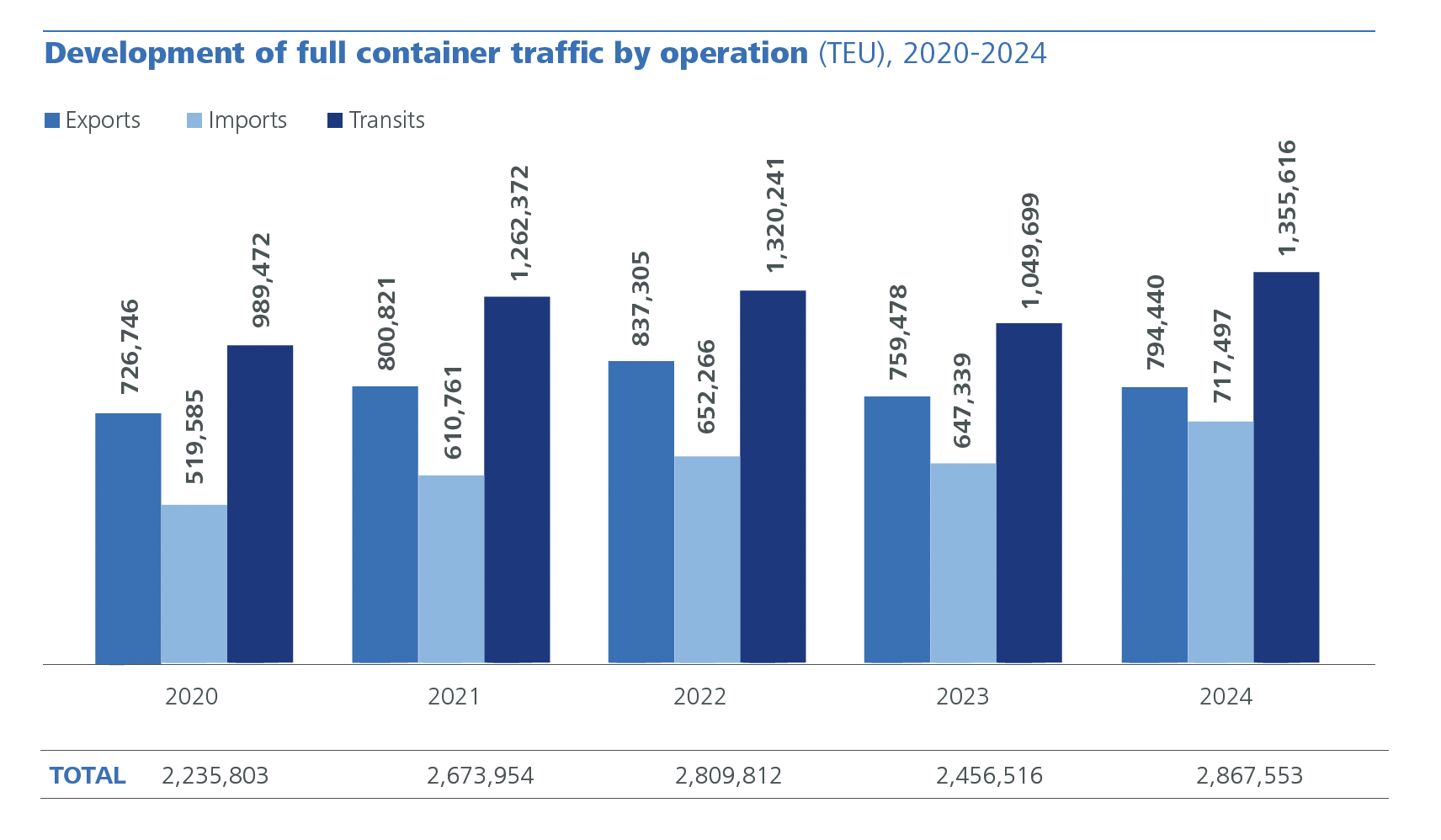
Also worth highlighting is the 8% rise in full TEUs for external trade, fuelled by positive results in both imports (+11%) and exports (+5%).
In 2024, full export containers totalled 794,440 TEU (+4.6%), driven notably by the increase in the second half of the year, which was seen across virtually all representative sectors: chemicals, capital goods, food, feed and miscellaneous manufactured products.
This year growth was driven by the United Arab Emirates and China, the main target markets, followed by Saudi Arabia and South Korea. Exports to Algeria were virtually non-existent due to the trade blockade by that country’s government owing to the Spanish government’s position on the Western Sahara. In any case, the re-establishment of relations in the fourth quarter translated to a slight recovery at year-end.
This year pork exports (68,925 TEU) fell slightly (-1%) due to the decline in sales to China following the recovery of its pig population. Despite this, the Asian country remains the main target market, accounting for 43% of exports. The Philippines stands out among the markets showing a positive performance.
Moreover, alfalfa exports (38,260 TEU) were up 31% following the product’s recovery after a 2023 affected by weak demand and a drought that hurt production. Despite remaining well below past volumes, 2024 displayed an incipient recovery.
Target markets
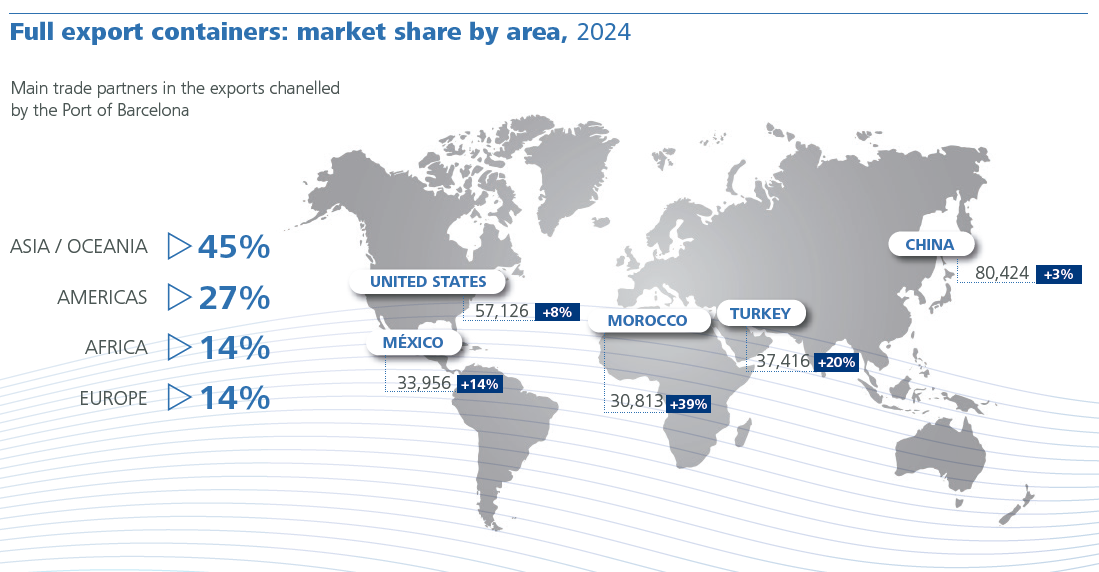
Asia/Oceania: received 45% of all export containers channelled by the Port of Barcelona in 2024. This year modest growth (+1%) was recorded, greatly influenced by declines in India and Indonesia, chiefly in paper waste, and in China, where the sharp drop in paper and pulp exports (-39%) kept total growth in trade with that country at 3%.
Americas: received 27% of the Port’s exports and the main destinations – United States (+7%), Mexico (+15%), Brazil (+12%), Chile (+12%) and Colombia (+27%) – logged significant increases.
Africa: with 14% of the Port’s export market share, Africa displayed a slight change in trend after recent years’ shrinkage of the North African market. This was also due to the end of Spain’s trade restrictions with Algeria (see above), which meant that 1,740 TEU could be exported in December – up from a monthly average of just 35 throughout 2024. The main recipients of exports from the continent were the markets of Morocco (+30%) and Egypt (+24%).
The attached map shows export market shares by area, as well as 2024 data for the five main trading partners – China, the United States, Turkey, Mexico and Morocco – in exports received from the Port of Barcelona.
Vehicles
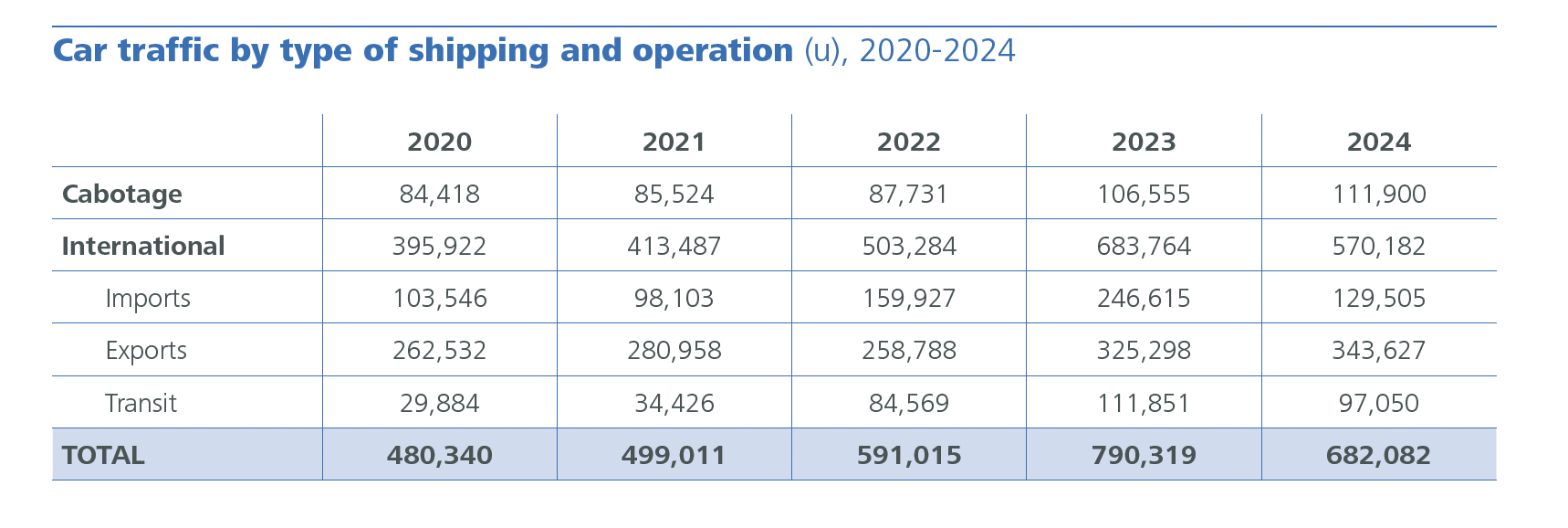
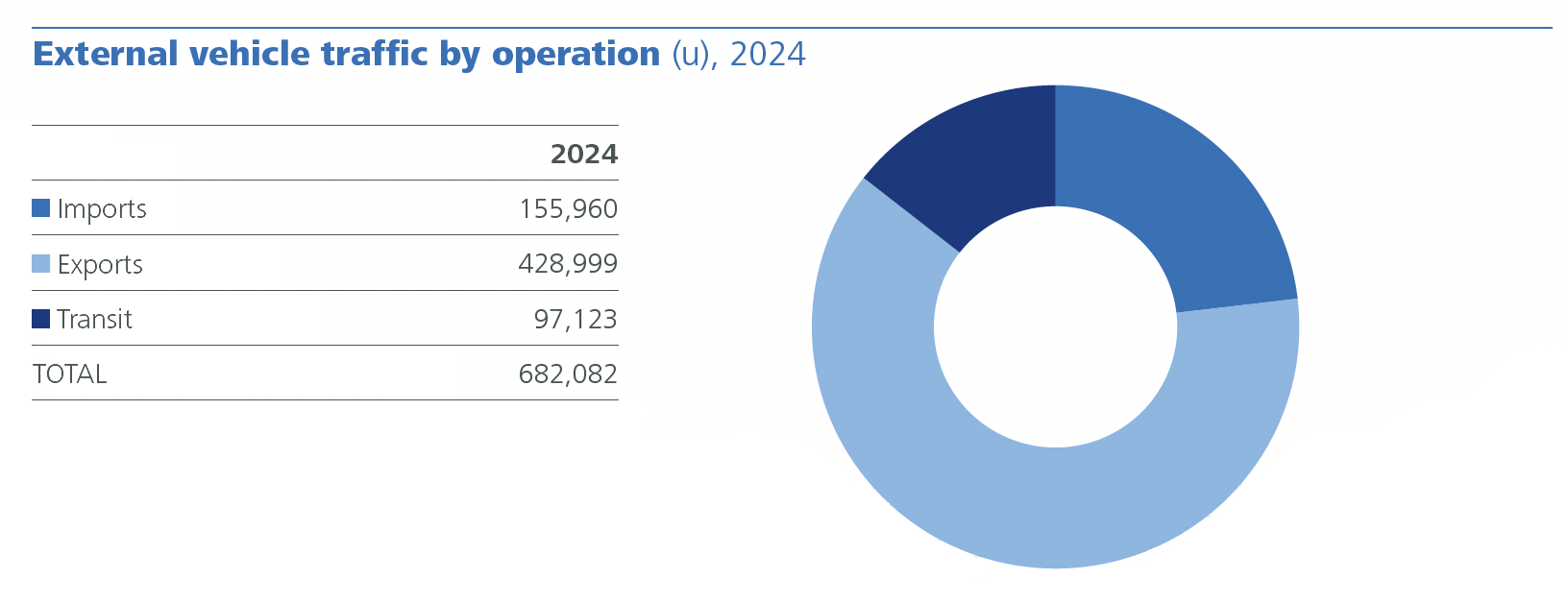
During this year, vehicle traffic stood at 682,082 units (-14%), a decline which was largely determined by the sharp drop in imports and transits. Of the total traffic, 111,900 units were cabotage in Spain and 570,182 international traffic.
Exports made up 63% of total vehicle traffic and showed positive growth, with a total of 428,999 vehicles (+4%), driven by the recovery from the component shortage crisis. As the year progressed, a stable and improving pace of parts supply enabled the growth of vehicle production and exports.
Imports made up 23% of total vehicle traffic and reached 155,960 vehicles (-40%), nearly 100,000 units fewer than the previous year, when such operations broke records. The main reason was the decline in import traffic from China – from 90,340 vehicles in 2023 to 34,864 this year – a result of the change in distribution strategy of one of the brands with the most activity during 2023.
Also significant to a certain degree were the situation at the Suez Canal – which reduced Barcelona’s competitiveness in terms of emissions and transit time – and insufficient space at the vehicle yard and the attendant diversion of ships in the first half of 2024. Nevertheless, this year new vehicle brands were incorporated that used the Port of Barcelona as a gateway to southern Europe.
To these figures must be added the approximately 60,000 vehicles that arrived in containers and compensated for insufficient capacity in car-carriers. As with vehicles arriving in ro-ro mode, these are deconsolidated in the car terminals for subsequent management. Namely, the units undergo pre-delivery inspections and are distributed by truck, train or ship.
Although the effect was not yet felt in 2024, many Chinese brands have already established operations in the European Union or are considering doing so to avoid EU tariffs on Chinese-made electric vehicles. One example is the agreement between Ebro and Chery, which recently opened the Ebro Factory at the site of the former Nissan factory.
The Port of Barcelona experienced a 21% drop in operations of this type, which made up 14% of all traffic. These mainly involve ships arriving from the Far East and linking to closer countries such as Italy, Belgium and the Balearic Islands.
Achievements in 2024
To consolidate the Port of Barcelona’s position as a distribution hub for the Mediterranean and northern Europe, further efforts were dedicated in 2024 to developing European-gauge rail services to enable the transfer of goods from ship to train and thus reduce the use of trucks in the last mile. There are currently weekly services to Germany, Austria and France (see “Rail Services” section in the Management chapter).
Five car-carriers were supplied liquefied natural gas (LNG) in a total of 10 bunkering operations. For the new vehicles sector, key for Barcelona’s port activity, this marks a new milestone in the decarbonisation of the logistics chain.
The Port of Barcelona Management Board has approved the call for tenders for the concession of a third public vehicle terminal at Príncep d’Espanya wharf.
During 2024 a total of 13,688,693 tonnes (+6.3%) of liquid bulk were registered, an increase driven especially by the behaviour of gasoline traffic and natural gas inflows.
Hydrocarbons largely held steady compared to the previous year, with 9,377,546 tonnes handled. After the sharp global decline recorded in 2023, gasoline experienced a 40% recovery in transit traffic.
Natural gas closed the year slightly above 2 million tonnes (-34%), a sharp decline. Low domestic demand, due mainly to higher demand in the energy sector following the increased use of renewables in electricity generation, meant that the main regasification plants (such as Barcelona) operated at a loss. In addition, the Virtual Single Tanker policy and the Russia–Ukraine war favoured other regasification plants in the west, such as Huelva, since traders are seeking shorter routes and cheaper freight rates and have opted for routes to the Gulf Coast of the United States or to the North Sea.
Chemical products traffic doubled (+108%) to reach 2.4 million tonnes.
Biofuels fell by 30% to roughly one million tonnes.
Traffic in oils and fats – fairly stable given demand is mainly industrial – dropped slightly to 833,513 tonnes (-4%).
| 2024 | 2023 | 2022 | |
|---|---|---|---|
|
Liquid bulk (million tonnes) |
13.7 +6.3% |
13.0 | 15.6 |
At 4,799,502 tonnes total (+0.1%), dry bulk traffic marginally exceeded the all-time high recorded last year. This result was due to imports, which rose by 5%, while exports closed the year down 4%.
As a result of the prolonged drought, which pushed down domestic production, import traffic rose, buoyed mainly by maize (549,383 tonnes; +14%) and the leading dry bulk product, soya beans (1,672,187 tonnes total, +10%). Moreover, cement and common salt traffic fell (-12% and -5%, respectively), together accounting for nearly 1.3 million tonnes.
| 2024 | 2023 | 2022 | |
|---|---|---|---|
|
Dry bulk (million tonnes) |
4.8 +0.1% |
4.8 | 4.5 |
According to the definition of the European Short-sea Network, short sea shipping (SSS) is the maritime traffic of goods and passengers between ports located in European territory or between these ports and those located in non-European countries with a coastline in the seas surrounding Europe. In the Port of Barcelona’s case, SSS includes traffic with the Balearic and Canary Islands (cabotage) and freight travelling on the Motorways of the Sea (regular services between Barcelona and various destinations in Italy and North Africa).
In 2024 this traffic – general cargo that is shipped by truck, platform, trailer, etc. – registered a new record high of 427,734 intermodal transport units (ITU). The 2.9% growth was split equally between external traffic/Motorways of the Sea and cabotage, with the latter logging a total of 267,108 ITU (+3.1%) – mostly with the Balearic Islands (264,353 ITU) and driven by an increase in tourism, or its stabilisation at pre-pandemic levels. Passenger transport with the Balearic Islands totalled 1,223,539 passengers (+4.7%).
Intermodal transport by type of shipping (ITU*), 2020-2024
| 2020 | 2021 | 2022 | 2023 | 2024 | |
|---|---|---|---|---|---|
| National island | 194,298 | 217,469 | 253,053 | 259,441 | 267,108 |
| Remaining SSS | 152,796 | 179,261 | 165,546 | 154,449 | 160,626 |
| Total | 347,094 | 396,730 | 418,599 | 413,890 | 427,734 |
*ITU (intermodal transport unit) is any means, self-propelled or otherwise, that is used directly or indirectly as a means of land transport
| 2020 | 2021 | 2022 | |
|---|---|---|---|
| Ro-Ro Traffic (thousand ITU) |
428 +2.9% |
414 | 419 |
Motorways of the Sea: In 2024 Barcelona shipped a total of 158,097 ITU (+2.3%) to Italy and Morocco on the Motorways of the Sea or short sea shipping (SSS) services. This volume of traffic is equal to the number of trucks that were diverted from roads to the more economically and environmentally efficient maritime mode. Cargo totalled more than 4.6 million tonnes (+0.4%). In addition, this type of service logged 515,898 passengers (-9%), still 20% below the pre-pandemic record of 2019.
In 2024 Barcelona shipped a total of 158,097 ITU (+2.3%) to Italy and Morocco on the Motorways of the Sea or short sea shipping (SSS) services. This volume of traffic is equal to the number of trucks that were diverted from roads to the more economically and environmentally efficient maritime mode. Cargo totalled more than 4.6 million tonnes (+0.4%).
In addition, this type of service logged 515,898 passengers (-9%), still 20% below the pre-pandemic record of 2019.
| 2020 | 2021 | 2022 | |
|---|---|---|---|
 |
428 +2,9% |
414 | 419 |
In recent years rail traffic has made steady progress and therefore helps to make the logistics chains passing through the Port more sustainable.
In 2024 close to 219,039 containers (-14.4%) entered or left the Port area by train, putting the rail share of containers at 10%, three points below the figure from 2023. This traffic was harmed by the numerous track closures to improve the rail network that occurred during 2024 and made it difficult to establish or maintain intermodal supply chains.
Operational difficulties in the construction work to adapt the Castellbisbal head to the new gauge led to a decline in rail vehicle traffic, which fell to 295,059 units (-4.6%). However, the rail share of vehicles made up 50.6% of total vehicle traffic – five points higher than in 2023.
Finished automobile logistics at the Port also involves receiving and shipping vehicles via land transport. These operations are conducted primarily with international UIC gauge trains, which account for roughly 80,000 more vehicle units that are managed comprehensively at the Port’s terminals and make it a key piece in the European distribution of many brands, both inbound and outbound.
| Containers (TEU): | Vehicles: | |
|---|---|---|
| Rail share | 10% | 50.44% |
In 2024 the Port of Barcelona’s rail services led to annual savings of 48,533 tonnes of CO2. The Port of Barcelona’s commitment to using rail and short sea shipping (SSS) meant removing a total of 327,898 trucks from the road this year and 3.4 million in the last ten years. These calculations are based on rail transport of containers and vehicles. For SSS, transport of semi-trailers with goods and transport of sales vehicles are considered.
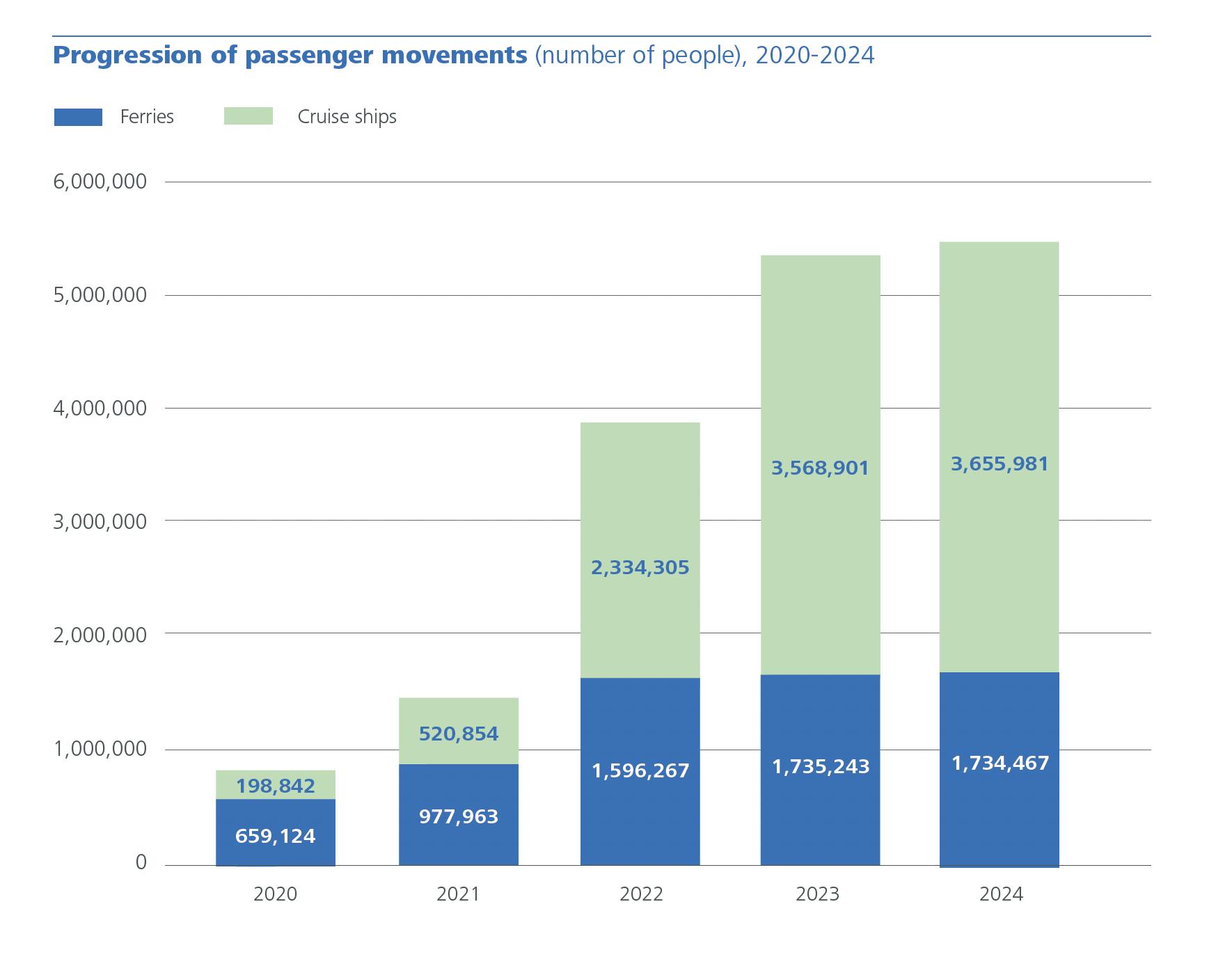
This year the overall recovery of passenger traffic was consolidated: the 5.4 million passengers (+1.7%) passing through the Port marked an increase of 16% relative to 2019, before the COVID-19 pandemic.
In ferry transport, the 1,739,467 passengers (+0.2%) recorded represented a slight increase over 2023 and set a new record.
Total passengers
(million people)
2024:5.4
2023:5.3
v. 2024/2023: +1.7%
Ferry passengers
(million people)
2024:1.739
2023:1.735
v. 2024/2023: +0.2%
Cruise passengers
(million people)
2024:3.656
2023:3.569
v. 2024/2023: +2.4%
In 2024, cruise activity marked another milestone: a record total of 3,655,981 passengers (+2.4%), representing 2.2 million visitors to the city. The number of stopovers – 793 – was down slightly (10 fewer than in 2023), putting the average capacity of the cruise ships calling at Barcelona at 87%.
Particularly relevant is that the recorded growth was seen exclusively in turnarounds, that is, passengers starting and/or ending their trip in Barcelona. These types of operations made up 56% of the traffic recorded in 2024, up 3% over the previous year.
The Port Authority closed the 2024 financial year with a net profit of €62.5 million (+25%), a year-on-year increase of €12.4 million which was driven by two factors:
This year, the Corporate Tax expenditure fell by €2 million over 2023. However, this will be the first year that this tax (€2.9 million) is settled, as there are no negative taxable bases left to offset.
Outturn for the FY (million EUR and %), 2024-2023
| 2024 | 2023 | Variation | % Var. | |
|---|---|---|---|---|
| Operating income | 50,157 | 43,961 | 6,196 | 14% |
| Financial results | 18,955 | 14,694 | 4,261 | 29% |
| Tax on profits | (6,614) | (8,584) | 1,969 | (23%) |
| Total | 62,498 | 50,072 | 12,426 | 25% |
In 2024 net turnover totalled €200.3 million (+6%), €11.2 million more than in 2023. This increase was due mainly to the positive development of income from port fees, which topped the previous year’s figure by €10.7 million (+6%), amid growth in the main traffic indicators (see previous section “Traffic data for the Port of Barcelona”).
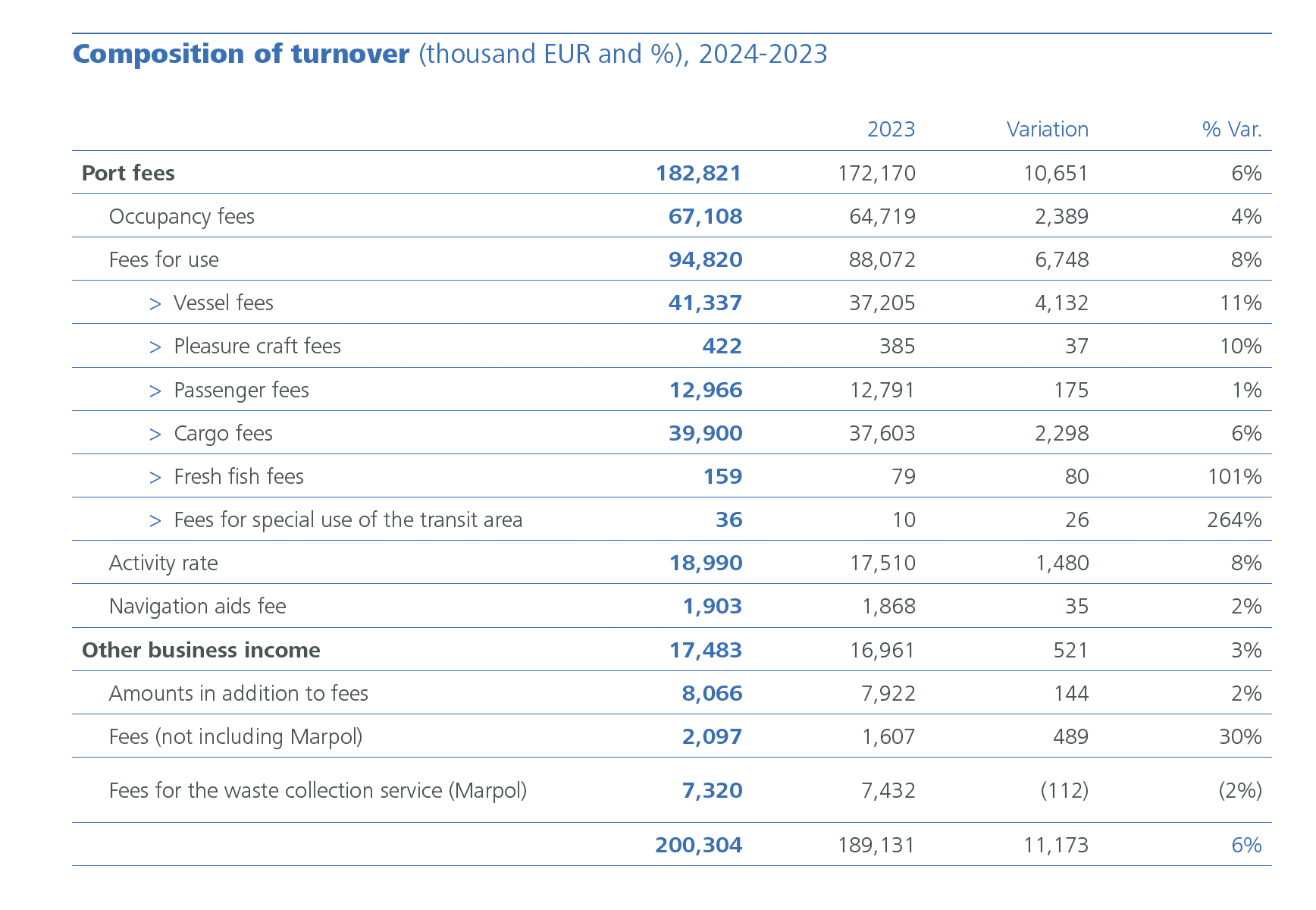
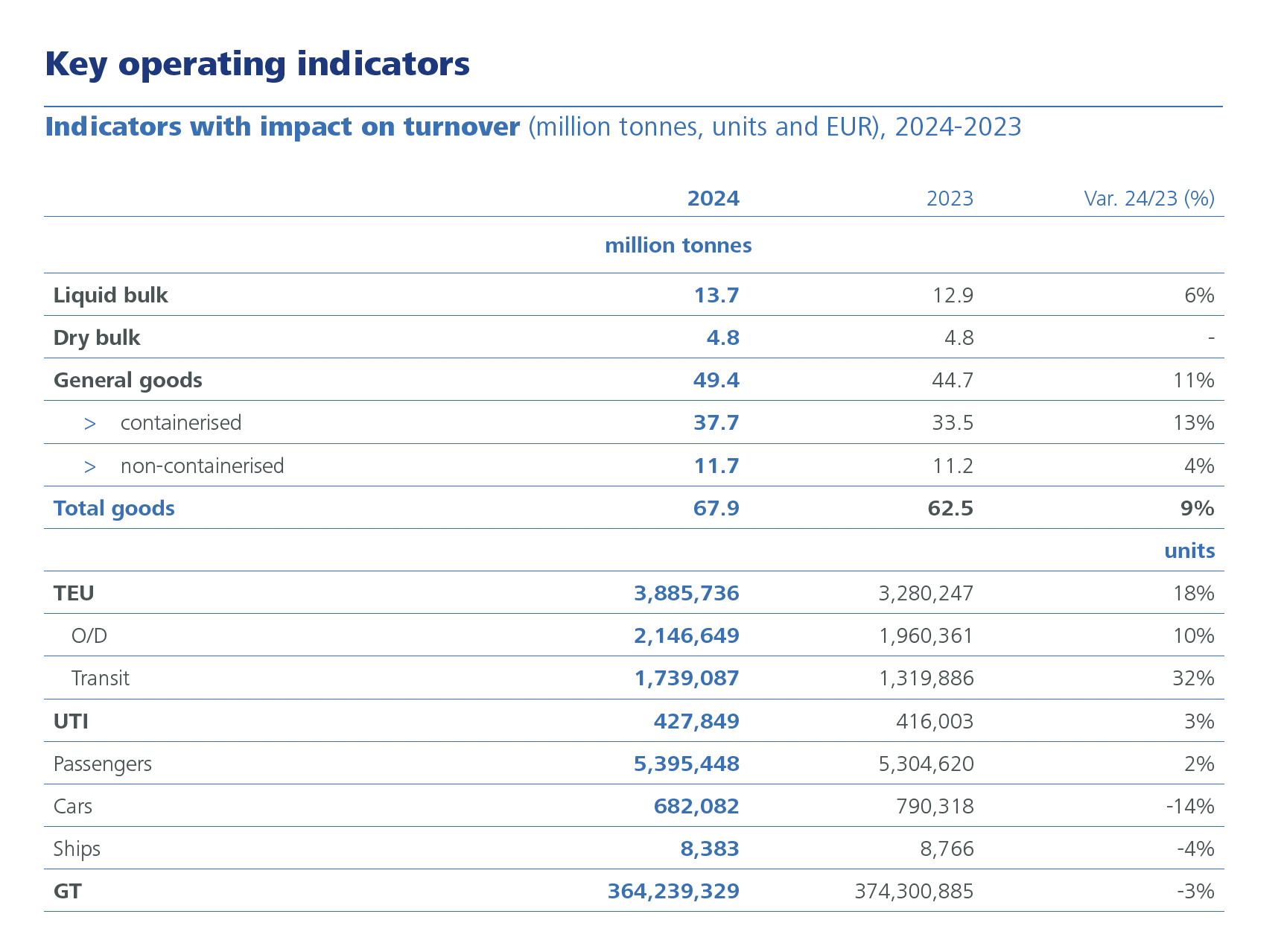
Traffic data had a positive impact on fees for use, which grew by €6.7 million (+8%), driven mainly by:
Revenue from concession fees (occupation and activity) grew by €3.8 million (+5%):
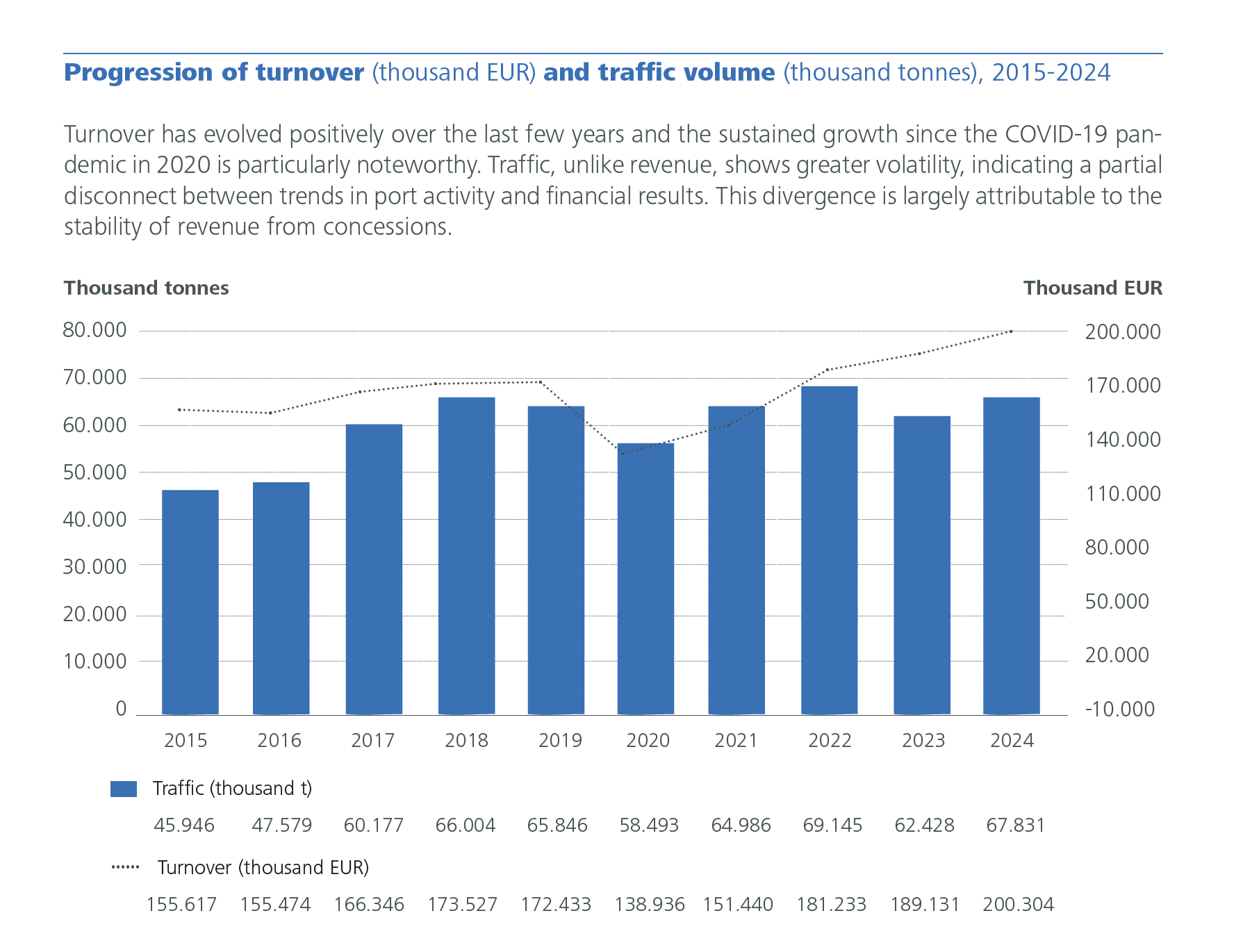
Progression of turnover (thousand EUR) and traffic volume (thousand tonnes), 2015-2024
Turnover has evolved positively over the last few years and the sustained growth since the COVID-19 pandemic in 2020 is particularly noteworthy. Traffic, unlike revenue, shows greater volatility, indicating a partial disconnect between trends in port activity and financial results. This divergence is largely attributable to the stability of revenue from concessions.
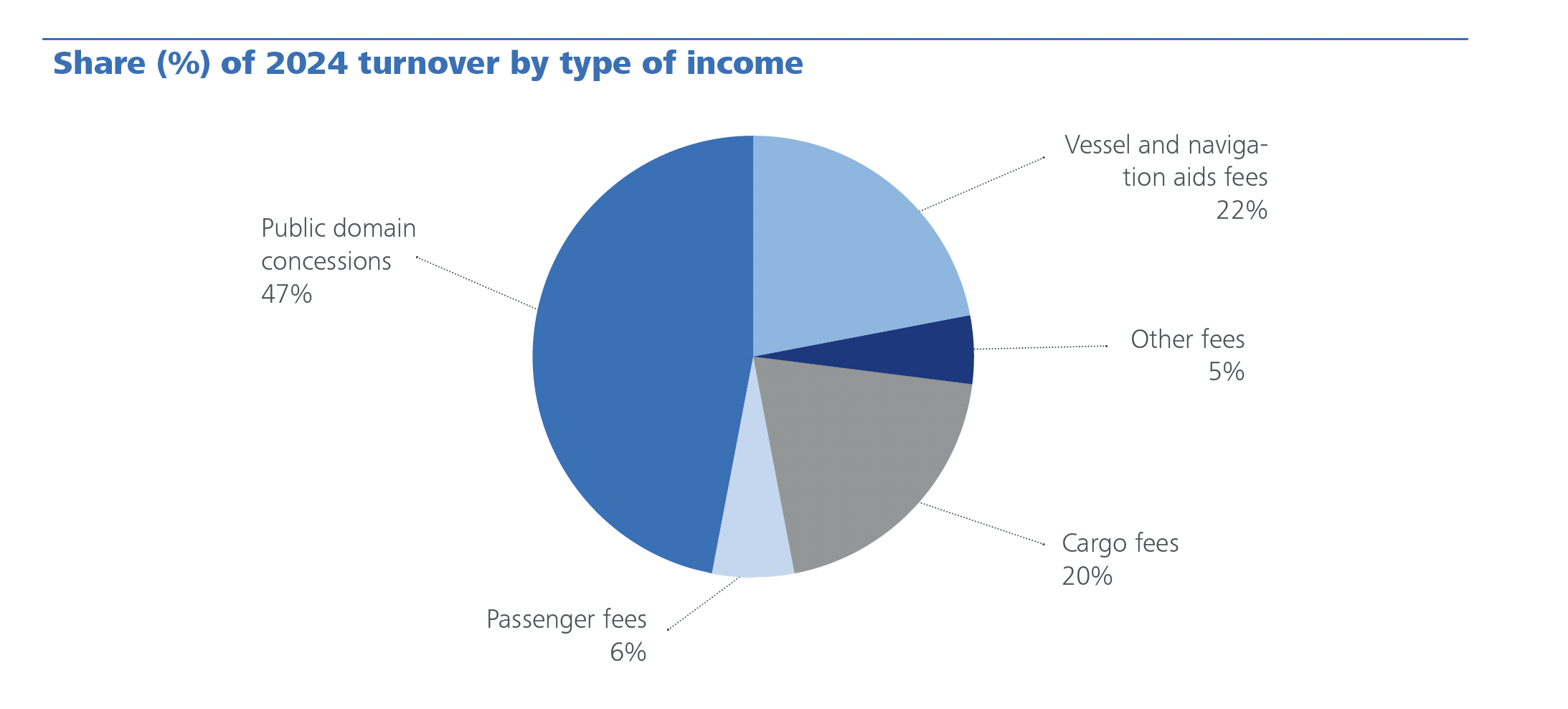
By type
In 2024, public domain concessions contributed nearly half of the Port’s revenue (47%), followed by vessel fees and navigation aids (22%) and cargo fees (20%), maintaining the same distribution as in 2023.
By type of activity
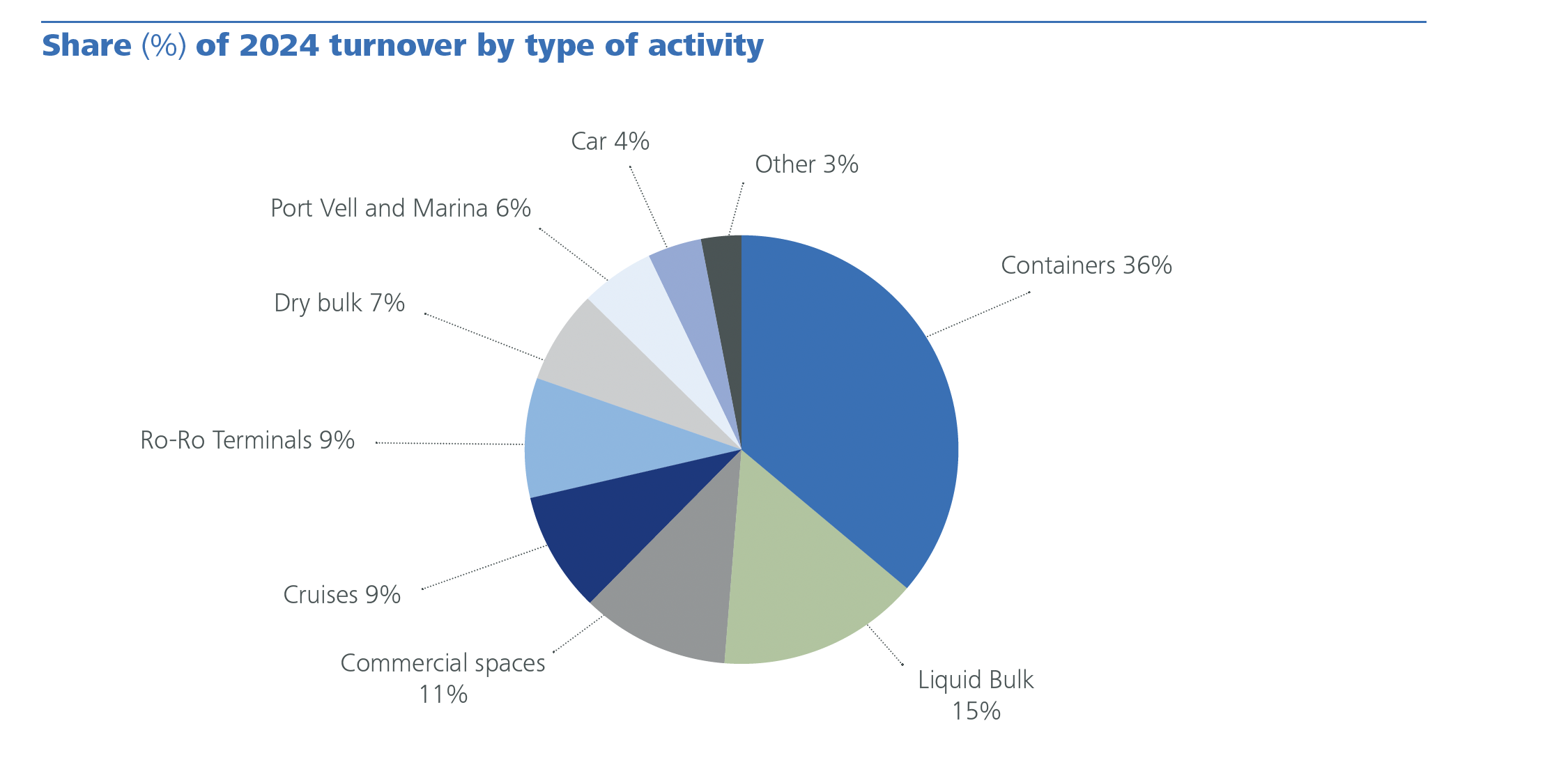
Also in line with previous years, revenue related to containers and liquid bulk accounted for more than half of activity (51%).
In 2024, spending totalled €160.8 million (+6%), an interannual uptick of €9 million. On the one hand, notable increases were recorded in ‘Other exceptional expenses and income’ (€9 million), ‘Staff costs’ (€2.3 million) and ‘External services’ (€2.3 million). On the other, ‘Other current management expenses’ were half those of 2023.
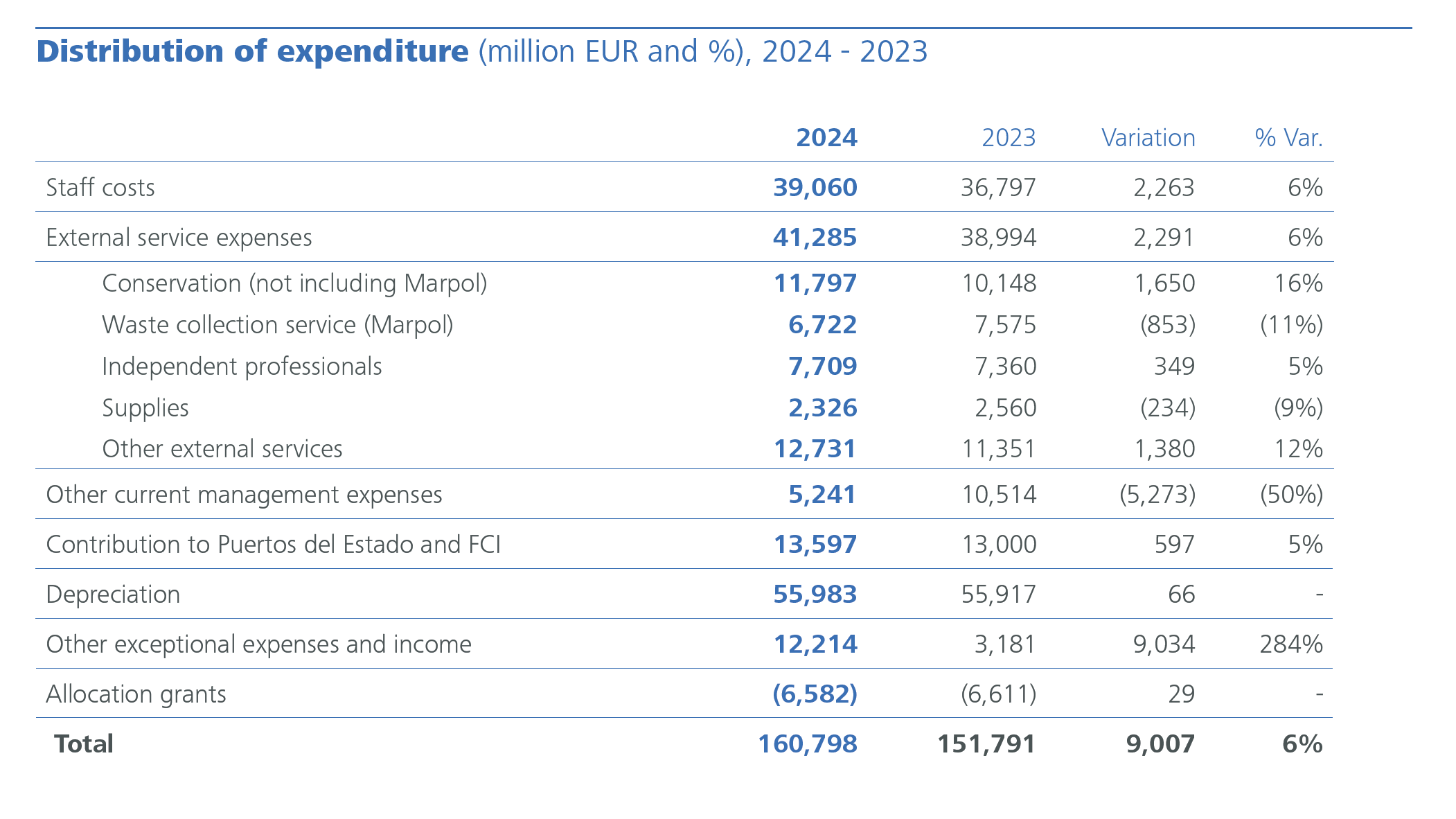
This type of spending climbed to €39.1 million (+6%) due to the following factors:
Expenditure on external services increased by €2.3 million to reach €41.3 million (+6%), mainly due to:
Current management expenses were halved because €10.5 million in expenses related to compensation for the transfer of the Port Nou Terminal (€5.4 million) and a provision for litigation related to land for the new accesses (€3.4 million) were recorded last year.
Of the €5.2 million recorded this year, €3.2 million corresponded to port-city actions by APB in preparation for the America’s Cup (developing the New Entrance and shipyard), and €940,000 to additional compensation for the Port Nou Terminal transfer.
‘Other exceptional expenses and income’, which increased by €9 million, includes the provision for impairment of the investment to remodel the historic warehouses (tinglados) of the Eastern wharf, used as the Port’s hospitality headquarters during the America’s Cup, as no near-term plans exist to transfer these to third parties under a concession regime (this provision is reversible).
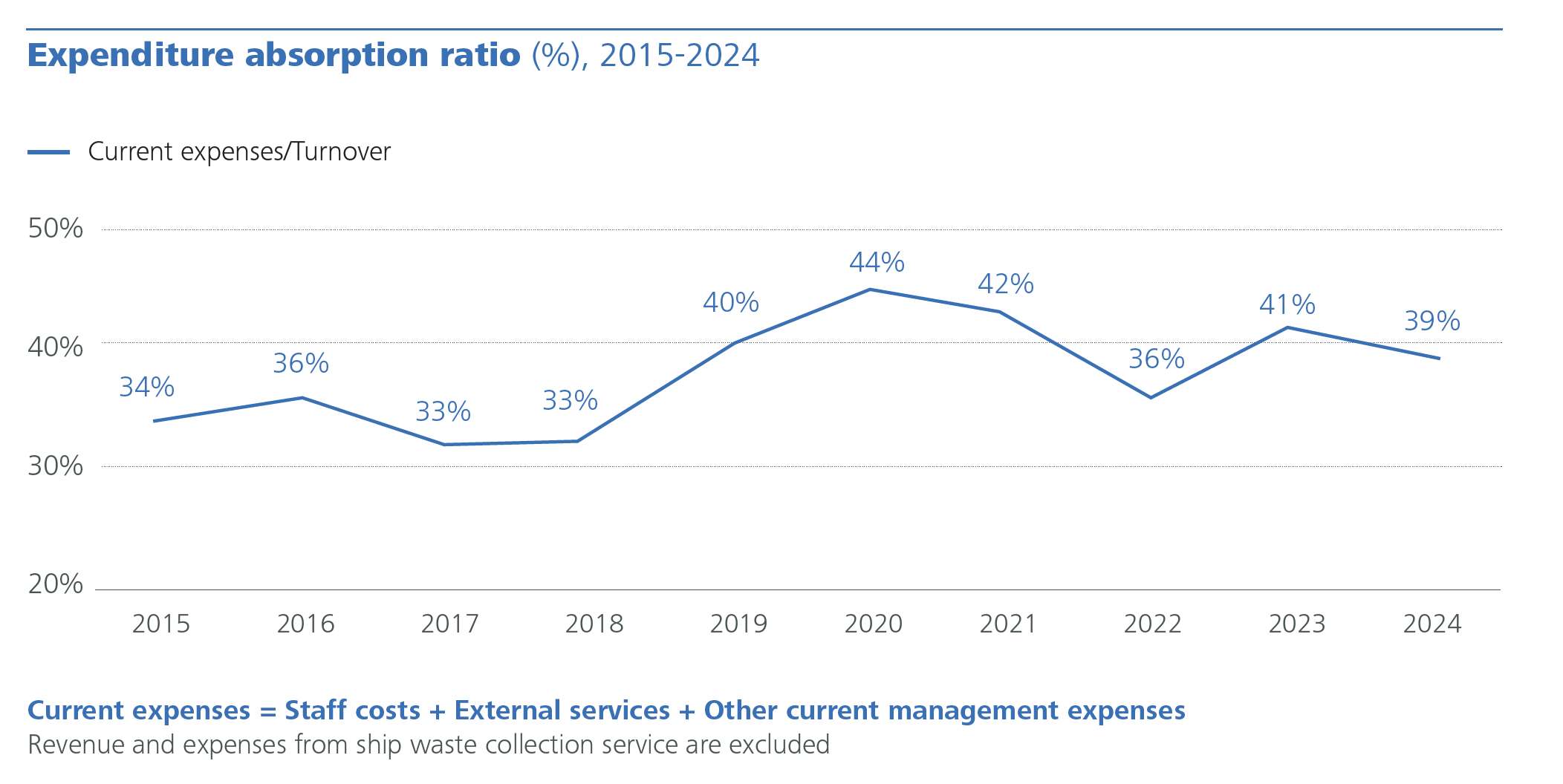
Current expenses = Staff costs + External services + Other current management expenses.
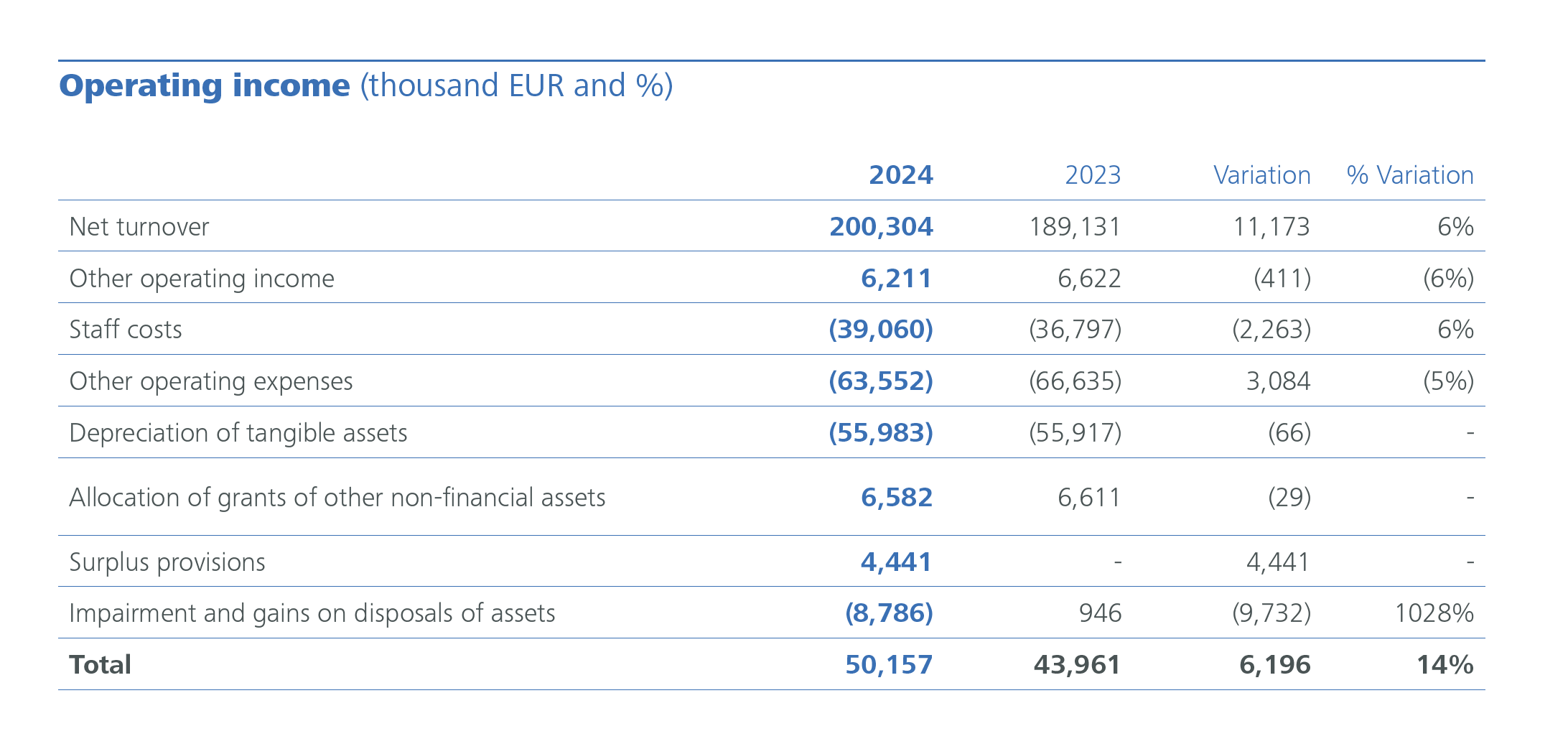
In 2024 operating income reached €50 million, an interannual increase of €6.2 million (+14%). This positive result stems from increased turnover, along with the reduction in ‘Other operating expenses’ (€3.1 million) and the reversal of provisions (€4.5 million). These factors more than offset the increase in expenses, stemming from the accounting treatment of certain actions carried out in the port-city area to host the America’s Cup, recorded under ‘Impairment and gains on disposals of assets’.
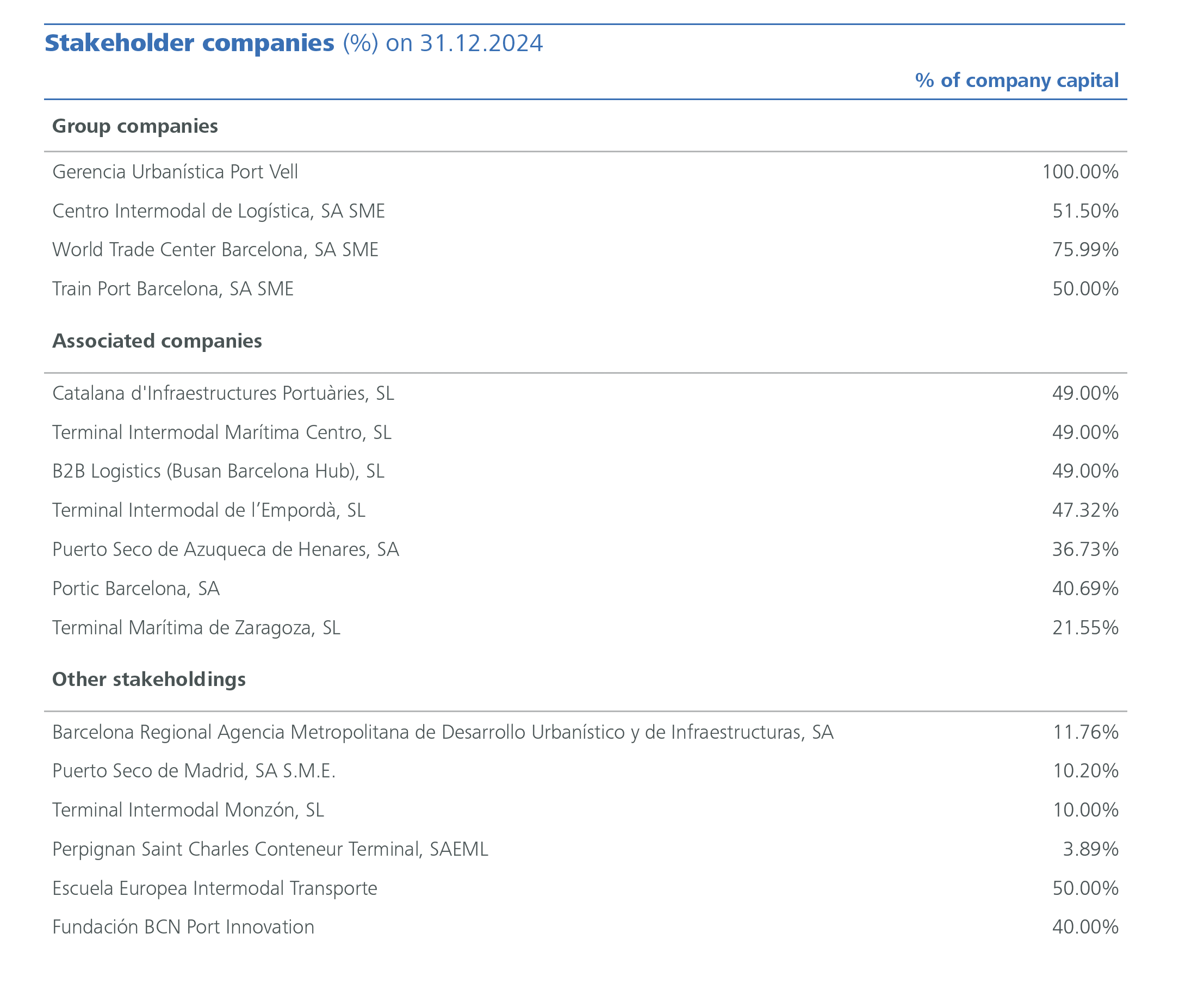
During 2024, the group of companies in which Barcelona Port Authority (APB) holds a stake grew with the addition of Train Port Barcelona, S.A., SME, which is owned equally by the APB and rail operator ADIF and aims chiefly to integrate rail services within the port area, thus improving connectivity and efficiency in freight transport. In the short term, Train Port will manage the Barcelona Rail-Port Management Centre, while in the medium and long term it is expected to also manage the terminals of the Barcelona rail node.
At year-end, a total of 17 companies made up the Port of Barcelona organisation, each dedicated to one of the three main branches of the business: managing spaces; rail terminals; or technological improvement, innovation and services. Together, these companies account for €145 million in turnover.
In 2024, APB recorded a positive result of nearly €19 million, up 29% year on year from €14.7 million.
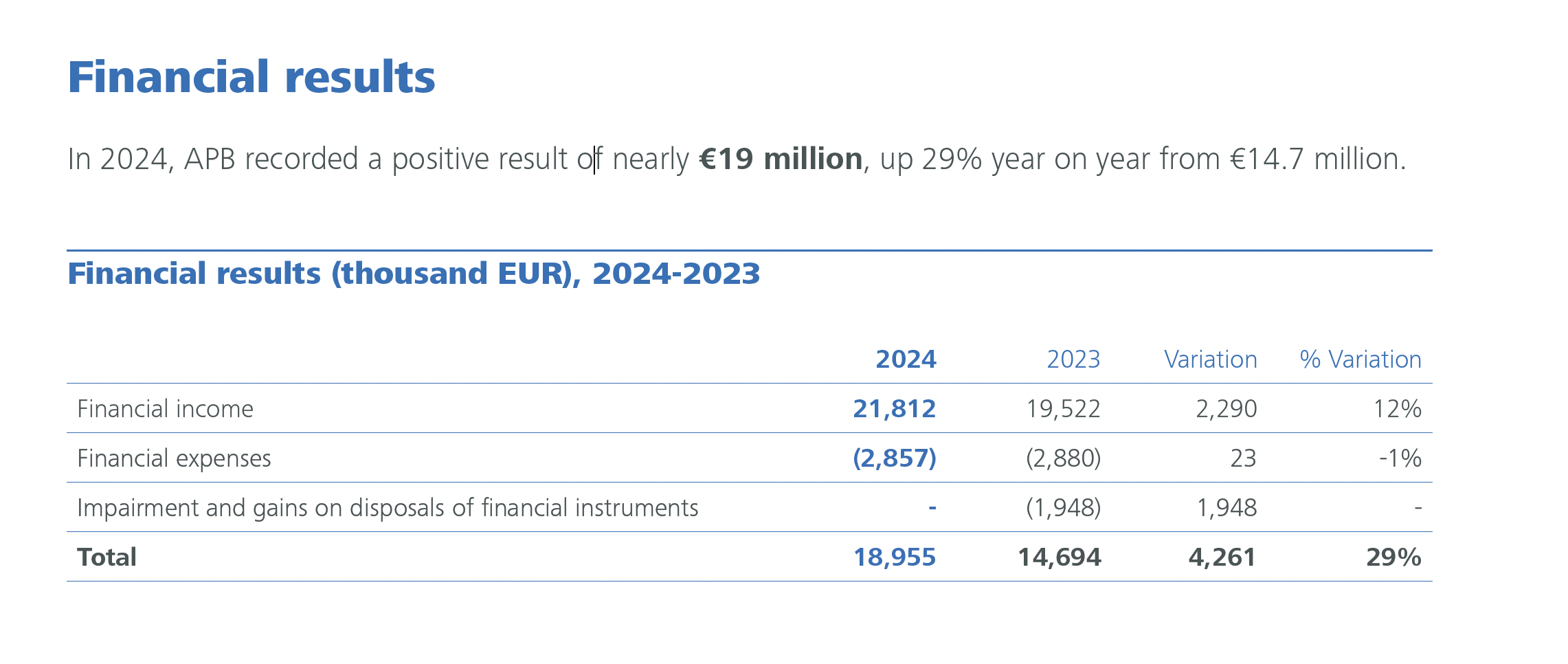
Financial income increased primarily due to the profitability of managing cash surpluses. Dividends, despite not having increased, continue to represent a significant source of income.
Management of cash surpluses
During 2024 several temporary financial investments (IFT) were made, generating €9.5 million in revenue, which more than offset financial expenditure from higher interest rates. The average rate of these investments at year-end was 3.50%. Additionally, remuneration on current accounts reached €1.5 million. Overall, income from this management increased by €4.1 million compared to 2023, a 60% rise.
Stakes in equity instruments
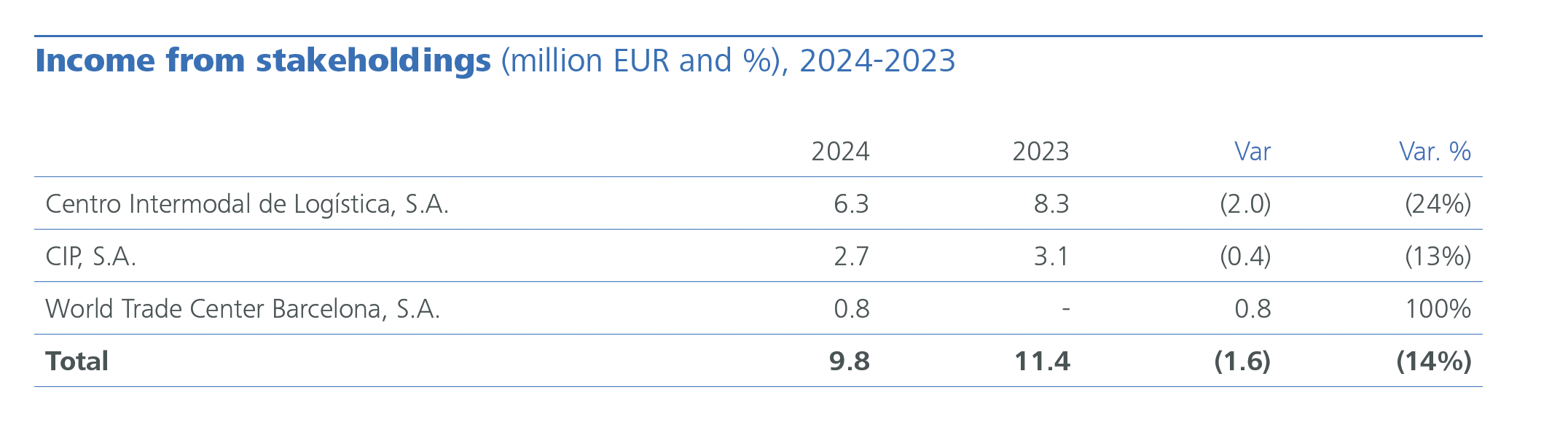
Income from dividends reached €9.8 million (-14%). Despite the reduction of dividends from CILSA and CIP, €760,000 were received from WTCB, which had not distributed dividends the previous year.
The economic situation drove up interest rates on the loans that APB maintains with the European Investment Bank. Interest rates reached an average of 2.278%, resulting in financial expenses of €2.8 million in the current year, in line with the previous year.
During 2023 the carrying value of the stakeholder company Terminal Intermodal Marítima Centro, S.L. was impaired by €2.1 million. Conversely, part of the impairment recognised in Puerto Seco de Madrid, S.A., SME was reversed by €175,000 following a new valuation carried out by the company’s partners. No amounts were recognised under this heading in 2024.
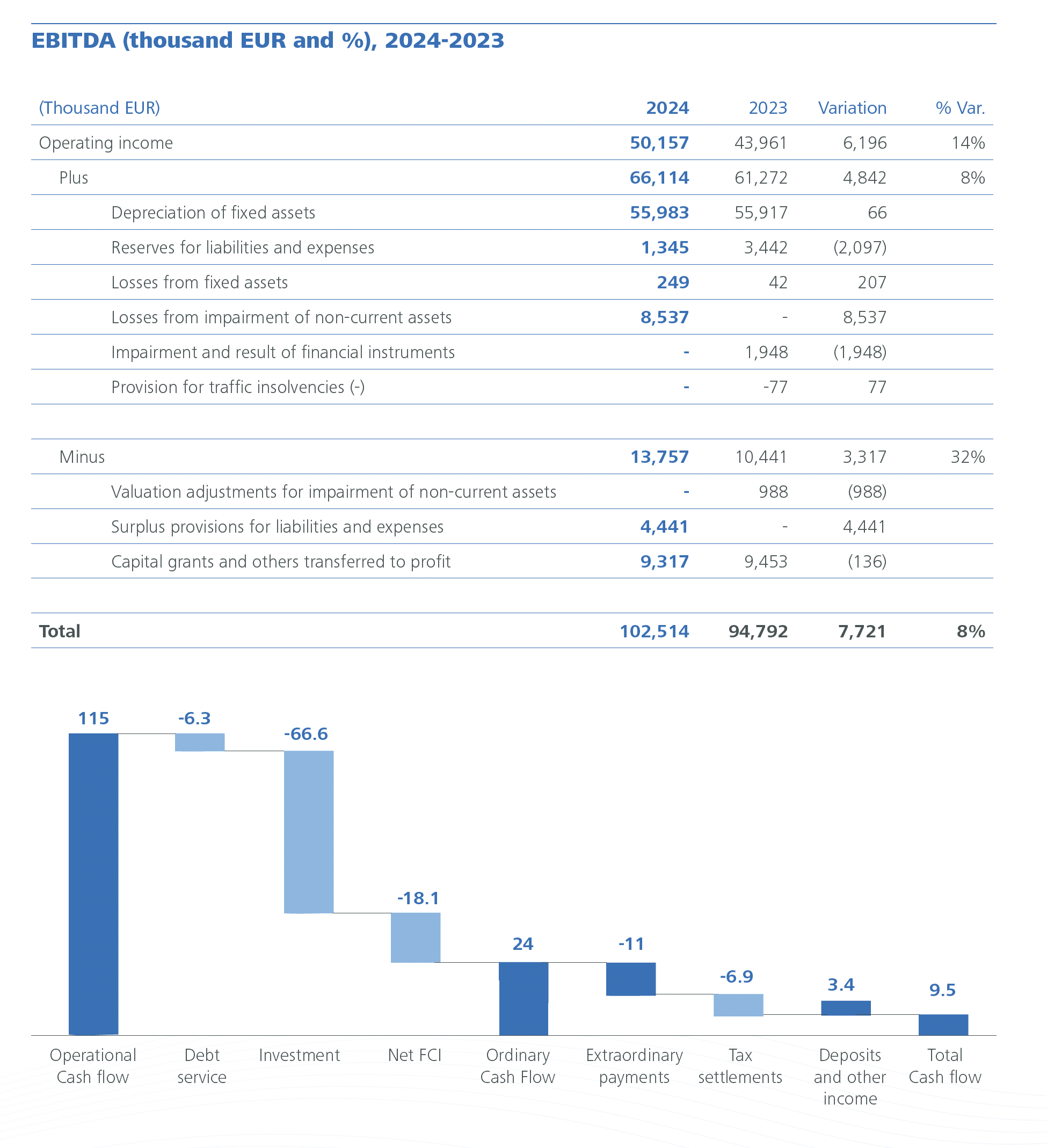
Earnings before interest, taxes, depreciation and amortisation (EBITDA) reached €102 million (+8%), mainly due to the improvement in operating income by €6.2 million.
Cash generated from operations produced an operating cash flow of €115 million (+14%), consistent with the increase in operating income. Consequently, APB’s ordinary activity, after paying loans, investments, and taxes, generated €9.5 million in cash.
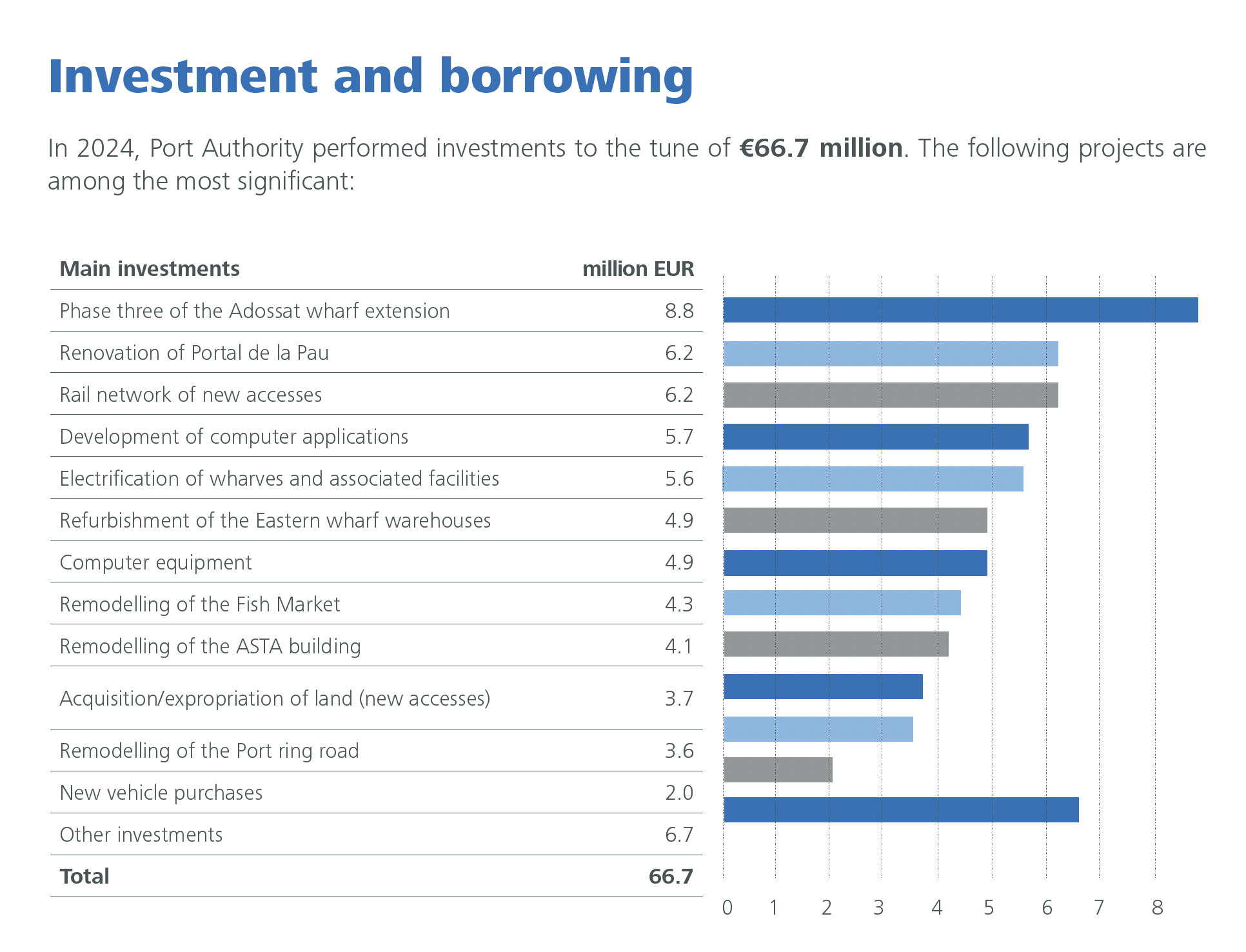
In 2024, Port Authority performed investments to the tune of €66.7 million. The following projects are among the most significant:
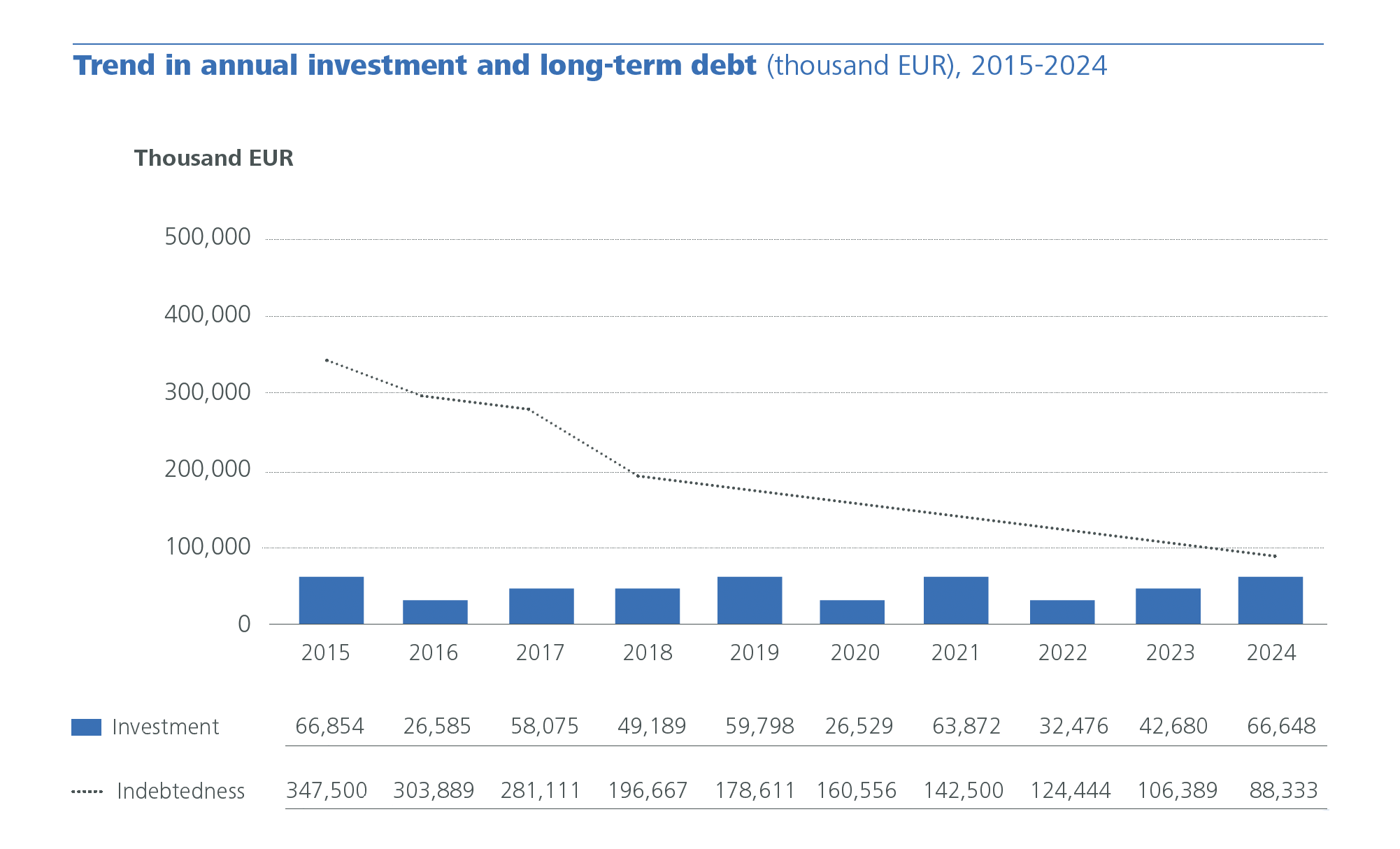
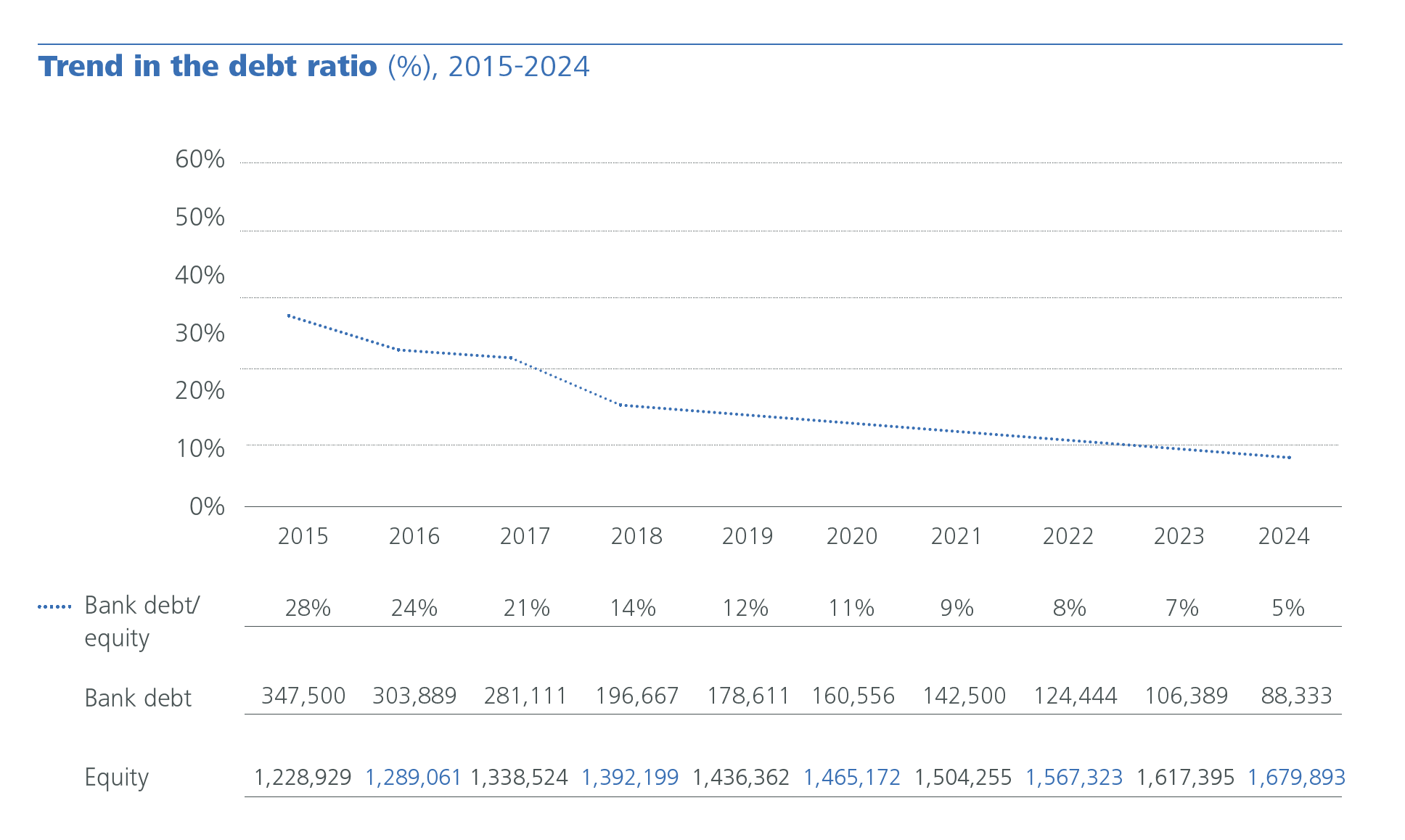
Since completion of the Port’s most recent expansion project (Master Plan 1997-2011), which was highly financially leveraged (roughly €500 million in 2010), the debt ratio has decreased considerably due to the progressive effect of debt repayment through early returns, as well as the application of profits to assets. This year a long-term debt-to-equity ratio of 5.3% was reached, the lowest percentage in recent decades.
Article 19 of Royal Legislative Decree 2/2011, approving the Recast Law on State Ports and the Merchant Navy, states that the economic resources of the public body Puertos del Estado (OPPE) shall comprise, inter alia, 4% of the revenue accrued by port authorities from port fees over the previous financial year.
In addition to funding the OPPE, port authorities must also make contributions to the Interport Compensation Fund (FCI), an instrument for redistributing the resources of the state port system regulated under Article 159 of the same law. Since 2019, the contribution has been higher due to the creation of the new “Ports 4.0” capital fund, aimed at promoting and incorporating incremental innovation as an element of competitiveness and efficiency in the logistics and port sector.
In 2024 the Port of Barcelona’s net contribution to the FCI was €6.33 million, compared with €5.96 million the previous year, while the contribution to Puertos del Estado increased to €6.9 million. The increase in turnover in recent years explains the upward trend of these two contributions shown in the graph below.
Port authorities also contribute to the Port System via remunerated loans to the Financial Fund for Land-Port Accessibility (FFATP), a solidarity mechanism provided by law for financing external port access. This year and last, no contributions were made by common agreement within the Port System.
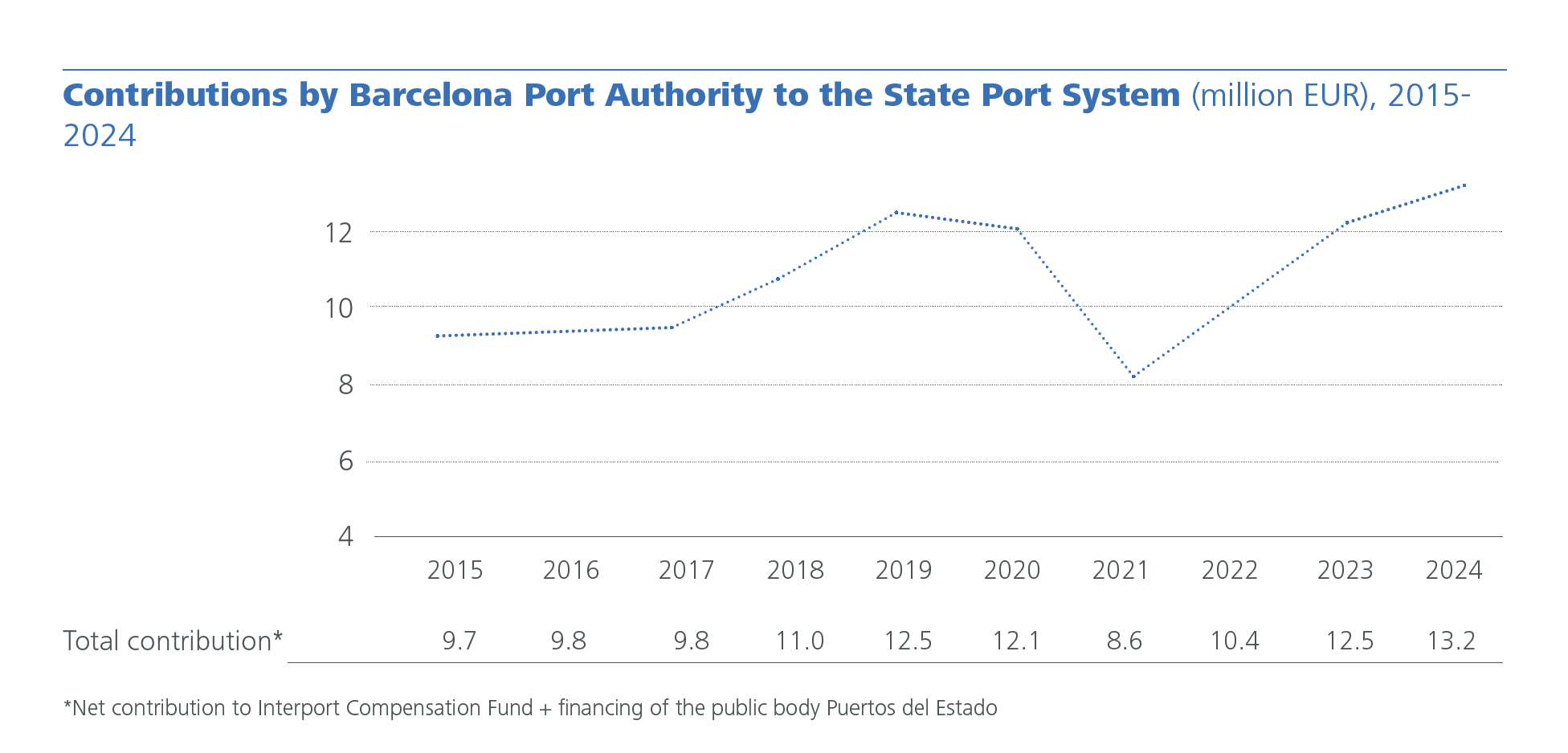
*Net contribution to Interport Compensation Fund + financing of the public body Puertos del Estado
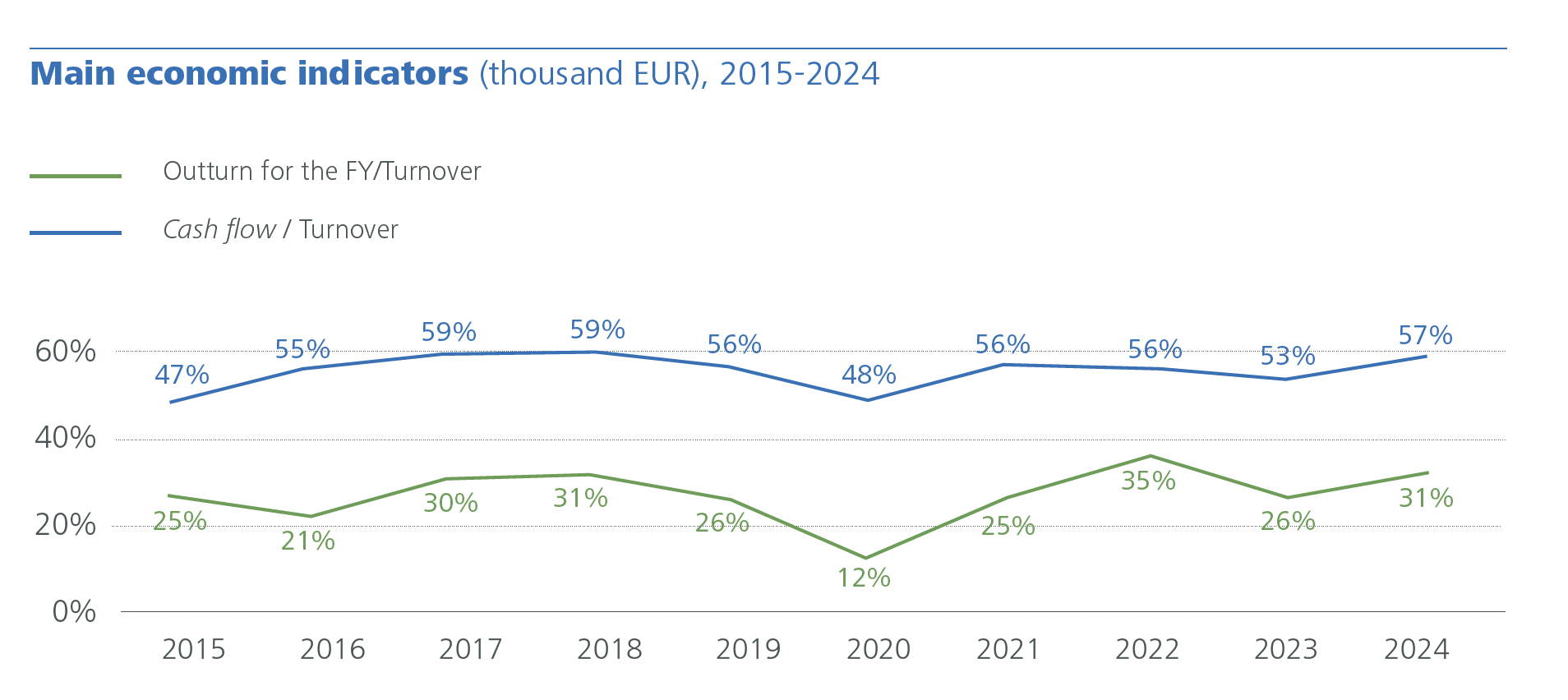
Between 2015 and 2024, the ratio of yearly results to turnover grew by 6%, rising from 25% to 31%. This growth was interrupted in 2020, an atypical year due to the COVID-19 pandemic, when it dropped to 12%. The ratio of cash flow to turnover has also followed a positive trend, rising from 47% in 2015 to 57% in 2024.
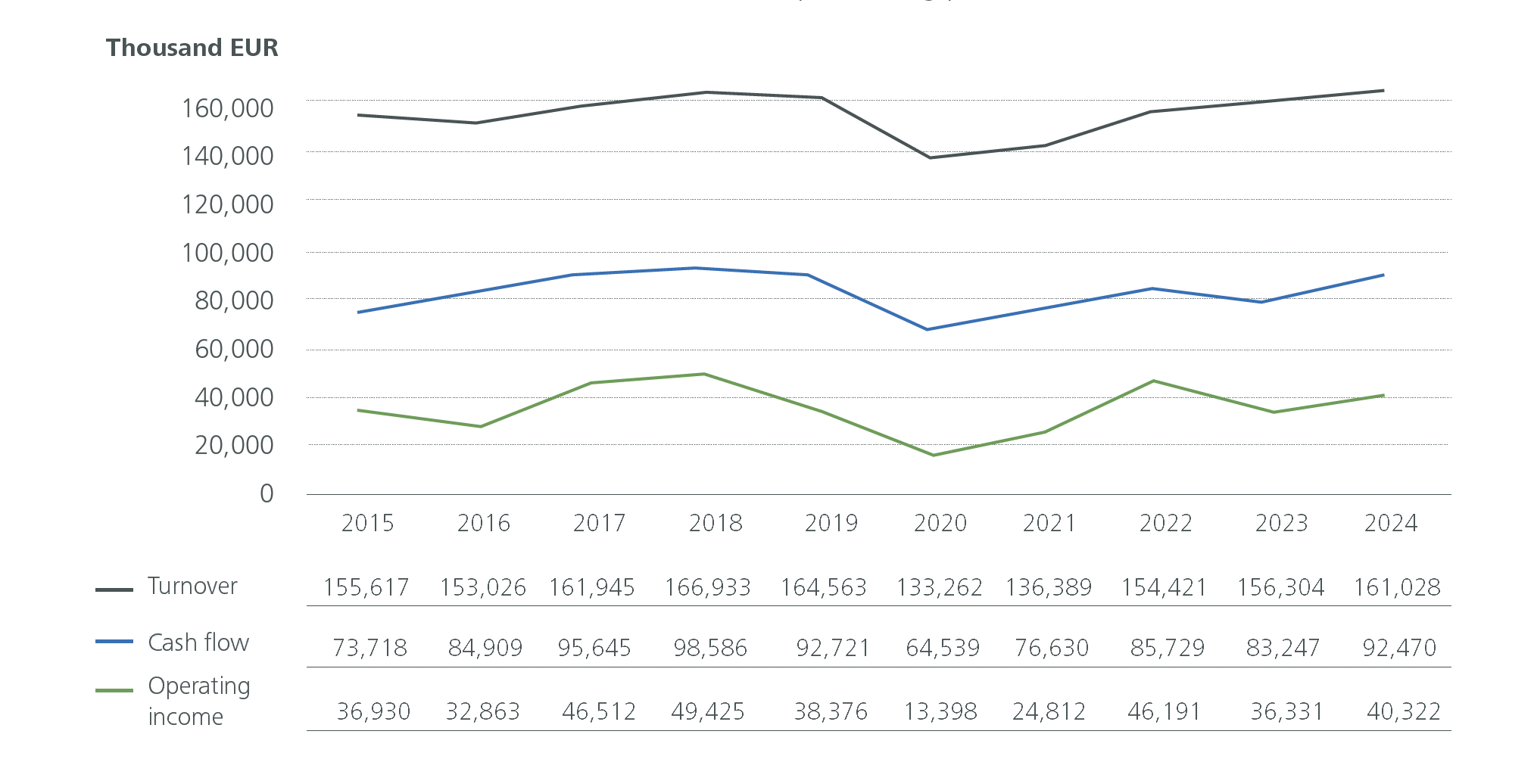
Since 2015, turnover has increased by €44.6 million – cumulative growth of 29% – while operating income has risen by €13.2 million (+36%), maintaining a similar ratio relative to turnover (around 25%). Regarding cash flow, the percentage increase has been even more significant: from 2015 to 2024 it rose 56%, a €41.3 million increase largely due to the particularly positive performance in 2024.
Below is the evolution of the main economic indicators in real terms, adjusted for inflation with 2015 as the base year. Compared with the absolute values in the previous graph, the main difference occurs in the last four years due to rising inflation (average CPI 4.5% since 2021), a higher impact than between 2015 and 2020 (average CPI 0.7%).
Analysis in constant terms shows that, despite nominal increases in recent years, turnover has risen only €5.4 million (+3.5%), even though overall Port activity grew 47.6% (in tonnes of goods). Cash flow, influenced by investment execution, increased €18.8 million (+25.4%) to reach €92.5 million in 2024. Operating income grew €3.4 million (+9.2%) while maintaining its ratio relative to turnover. This analysis highlights the need for new strategies to prevent loss of purchasing power.
uring 2024 the Port of Barcelona committed a total investment of over €66.7 million, including €61 million for infrastructure. The most relevant actions carried out this year are described below.
Awarded to: Ute nova rehabilitació Portal de la Pau
Performance time: 24 months (underway)
Budget: €15,629,051.73
The project involves renovating the Portal de la Pau building, headquarters of Barcelona Port Authority, to adapt it for a new functional use. When the works are completed, the building will reopen to the public and house a centre for disseminating port activity. The works include structural reinforcement and interior and exterior restoration, and adaptation to current energy efficiency, environmental and safety requirements.
Phase one, completed summer 2024, restored the main façade and consolidated the structure. To avoid interfering with the 2024 America’s Cup, work was temporarily halted between 1 August and 31 October. Phase two, initiated after the event, centres on restoring the interior and recovering the original structure.
The project has received public funding from the 2% Cultural programme to conserve sites of architectural, historical and artistic interest.
Awarded to: Ute tinglat moll Oriental
Performance time: 13 months (work completed)
Budget: €5,792,000
Between the Eastern and Llevant wharves and Passeig Joan de Borbó is a group of warehouses with outstanding architectural value, built in the early 20th century. All were in disuse for years and gradually deteriorated, so they were refurbished and restored to their original state.
The works were completed in time for the holding of the 2024 America’s Cup, during which three of the buildings served as a meeting point for the nautical community. The original aesthetics of the buildings have been recovered and, at the same time, the facilities updated. The buildings are named for their former uses, such as coal shed and small boat depot (Carbonera i dipòsit de petites embarcacions), carpentry shop (Fusteria) and metalworking workshop (Taller de metal·lúrgia). The roof of Carbonera has been rebuilt with metal trusses like those it had, while the roofs of Fusteria and Taller have been rebuilt with wood. Both warehouses are connected by wooden porticoes.
Awarded to: Ute ampliación muelle Adosado fase 3
Performance time: 8 months (work completed)
Budget: €5,448,952
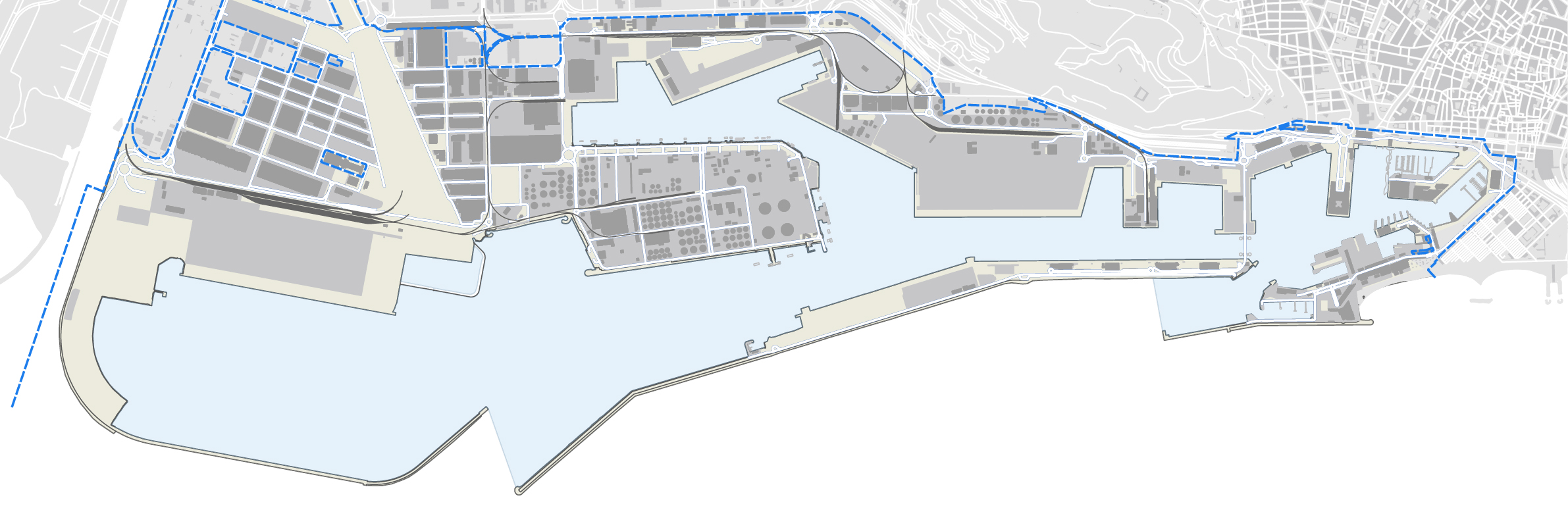
The plans for expansion and development of cruise ships at the Port of Barcelona include consolidating this cruise activity at the Adossat wharf and siting a future terminal H at the last alignment of the wharf, in the space occupied by Terminal Port Nou (TPN).
The project entails construction of the edge beam for a 631.52 m section of the Adossat wharf and the planned utility networks (water supply, telecommunications and medium voltage), along with the demolition and subsequent reconstruction of the southernmost 34.41 m of TPN. Also included is the construction of the sections of the esplanade’s transverse drainage pipes closest to the wharf and repair of pavement cracks at the southern end of the TPN esplanade.
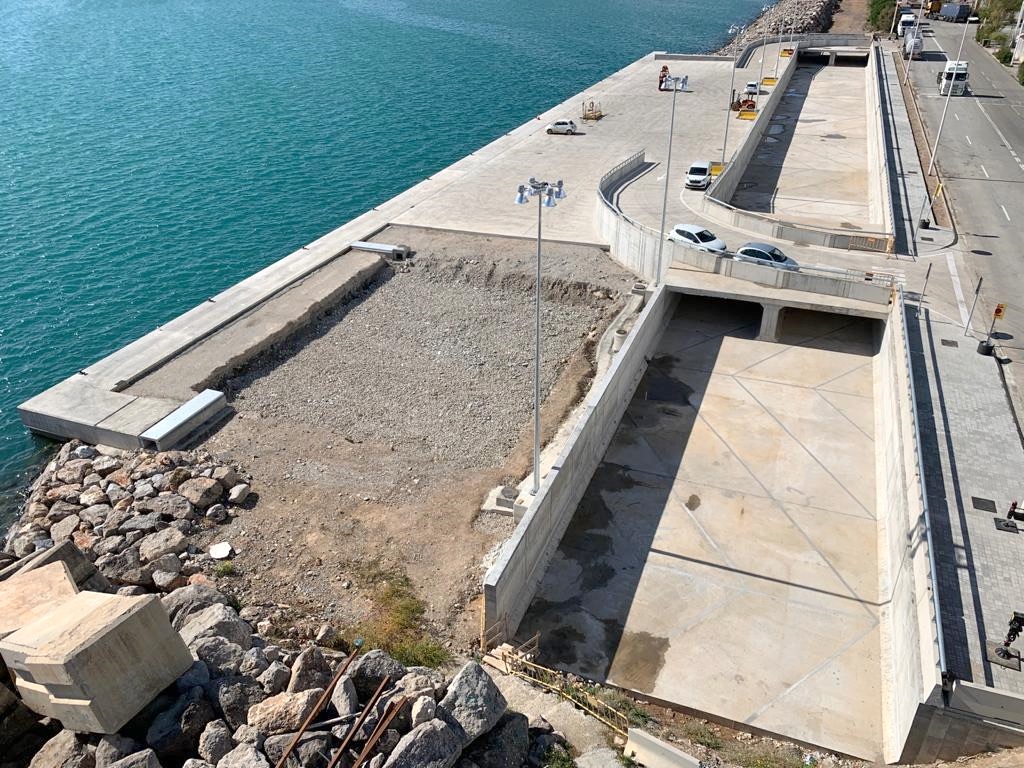

Awarded to: Ute nou accés ferroviari
Performance time: 24 months (underway)
Budget: €24,947,508
The “Collaboration protocol for the promotion and realisation of the new rail access to the Port of Barcelona (13 September)” was signed between various administrations (Ministry of Transport, Puertos del Estado, ADIF, FGC, Generalitat and Port of Barcelona) to promote the new rail access to the Port of Barcelona – part of the Recovery, Transformation and Resilience Plan (PRTR), with funding from the Recovery and Resilience Facility (RRF) of the European Union.
The work, performed by Barcelona Port Authority, includes the construction of the rail superstructure within the Port, including an access branch line and a set of tracks at the TERCAT terminal; the access roads and dispatch-reception lines in the Nou Llobregat area, including the electrification and traction substation, and the proportional part of the overall signalling project.
Plans also include the reinstatement of affected services, consolidation of the land, and geometric definition of the rail terminals; construction of the service road and embankment to connect with the new southern rail access developed by the Ministry, and realisation of all structures associated with the future rail terminal.
Awarded to: Cosplaan Obras Serveis Laantit, S.L.
Performance time: 16 months (work completed)
Budget: €2,435,807
The project involved extending the road running parallel to the back of the Port of Barcelona’s East seawall to provide service to the new cruise terminal („terminal H“, concessioned to the MSC company) to be built to the south of the Port Nou multi-purpose terminal, as well as to serve, in future, the ro-pax terminal, to be developed further south, also adjacent to the East seawall.
The characteristics of this road are similar to those in front of the cruise terminals already operating at the Adossat wharf. The scope of the project began at the southern end of the multi-purpose terminal and extended slightly farther south of the new cruise terminal H, with an approximate length of 557 m of roadway. This coincides with the exit area of the service pipes that will connect the service networks of the Adossat wharf with those of the Energy pier.
Awarded to: Acsa, Obras e Infraestructuras, S.A.U.
Performance time: 7 months (work completed)
Budget: €1,958,081
The construction work on the North Entrance breakwater was completed in December 2003, and in 2009, the surfaces of the emerging wall were reinforced and repaired. Some years later the infrastructure required new action. The Port Authority promoted the drafting of an appraisal report for implementation, including a more far-reaching refurbishment solution to restore the structure to its original state.
The project entailed restoration of the concrete surfaces on the Port and sea side to a depth, beyond the planes of steel reinforcement, of sound concrete. Once the concrete was restored, new GRP (glass reinforced polymers) were installed. The scope of action corresponded to the entire length of the back vertical seawall, roughly 526 m long.
Awarded to: Ute remodelació instal·lacions ed. Asta
Performance time: 42 months (underway)
Budget: €17,274,690
The work will improve the functional conditions of the ASTA complex, which consists of a main building and an annex building of the Port Police. Plans involve maintaining the current departments (Conservation, Archives and Port Police) and using an area of the main building as a rental for Port Authority concession companies.
To this end, a comprehensive refurbishment of both buildings is proposed, both at a functional level, as a new layout is planned for all floors, and at a structural level, as the façade, roof and roof reinforcements will be completely replaced. However, the existing floor slabs will be maintained almost in their entirety, with reinforcements to the foundations.
Awarded to: Eiffage Infraestructuras, S.A.
Performance time: 13.5 months (work completed)
Budget: €2,983,220
In recent years, the port area between the Ponent and Contradic wharves has undergone a significant transformation stemming from the implementation of a new ferry terminal. It has gone from an industrial and commercial area to a clearly urban space and completely open to the public. The scope of action included the section of the Port ring road, between the edge of the recently completed development in section 4 phase 2 and the roundabout at gate 28. Thus, development extended from the current access to the concession of APM TERMINALS BARCELONA, SLU (APM) to the roundabout located directly preceding.
Considering existing shortcomings made apparent by the proximity of the site to urban areas and by public transport improvements, which have increased pedestrian numbers in the zone, the works will improve road traffic flow, particularly pedestrian accessibility in the area. In this section, the Port ring road borders the facilities of the Companyia Logística d’Hidrocarburs, SA (CLH) and APM concessions.
Awarded to: Ute nova rehabilitació Portal de la Pau
Performance time: 24 months (underway)
Budget: €15,629,051.73
The project involves renovating the Portal de la Pau building, headquarters of Barcelona Port Authority, to adapt it for a new functional use. When the works are completed, the building will reopen to the public and house a centre for disseminating port activity. The works include structural reinforcement and interior and exterior restoration, and adaptation to current energy efficiency, environmental and safety requirements.
Phase one, completed summer 2024, restored the main façade and consolidated the structure. To avoid interfering with the 2024 America’s Cup, work was temporarily halted between 1 August and 31 October. Phase two, initiated after the event, centres on restoring the interior and recovering the original structure.
The project has received public funding from the 2% Cultural programme to conserve sites of architectural, historical and artistic interest.
Awarded to: Ute tinglat moll Oriental
Performance time: 13 months (work completed)
Budget: €5,792,000
Between the Eastern and Llevant wharves and Passeig Joan de Borbó is a group of warehouses with outstanding architectural value, built in the early 20th century. All were in disuse for years and gradually deteriorated, so they were refurbished and restored to their original state.
The works were completed in time for the holding of the 2024 America’s Cup, during which three of the buildings served as a meeting point for the nautical community. The original aesthetics of the buildings have been recovered and, at the same time, the facilities updated. The buildings are named for their former uses, such as coal shed and small boat depot (Carbonera i dipòsit de petites embarcacions), carpentry shop (Fusteria) and metalworking workshop (Taller de metal·lúrgia). The roof of Carbonera has been rebuilt with metal trusses like those it had, while the roofs of Fusteria and Taller have been rebuilt with wood. Both warehouses are connected by wooden porticoes.
Awarded to: Ute ampliación muelle Adosado fase 3
Performance time: 8 months (work completed)
Budget: €5,448,952
The plans for expansion and development of cruise ships at the Port of Barcelona include consolidating this cruise activity at the Adossat wharf and siting a future terminal H at the last alignment of the wharf, in the space occupied by Terminal Port Nou (TPN).
The project entails construction of the edge beam for a 631.52 m section of the Adossat wharf and the planned utility networks (water supply, telecommunications and medium voltage), along with the demolition and subsequent reconstruction of the southernmost 34.41 m of TPN. Also included is the construction of the sections of the esplanade’s transverse drainage pipes closest to the wharf and repair of pavement cracks at the southern end of the TPN esplanade.
Awarded to: Ute nou accés ferroviari
Performance time: 24 months (underway)
Budget: €24,947,508
The “Collaboration protocol for the promotion and realisation of the new rail access to the Port of Barcelona (13 September)” was signed between various administrations (Ministry of Transport, Puertos del Estado, ADIF, FGC, Generalitat and Port of Barcelona) to promote the new rail access to the Port of Barcelona – part of the Recovery, Transformation and Resilience Plan (PRTR), with funding from the Recovery and Resilience Facility (RRF) of the European Union.
The work, performed by Barcelona Port Authority, includes the construction of the rail superstructure within the Port, including an access branch line and a set of tracks at the TERCAT terminal; the access roads and dispatch-reception lines in the Nou Llobregat area, including the electrification and traction substation, and the proportional part of the overall signalling project.
Plans also include the reinstatement of affected services, consolidation of the land, and geometric definition of the rail terminals; construction of the service road and embankment to connect with the new southern rail access developed by the Ministry, and realisation of all structures associated with the future rail terminal.
Awarded to: Cosplaan Obras Serveis Laantit, S.L.
Performance time: 16 months (work completed)
Budget: €2,435,807
The project involved extending the road running parallel to the back of the Port of Barcelona’s East seawall to provide service to the new cruise terminal („terminal H“, concessioned to the MSC company) to be built to the south of the Port Nou multi-purpose terminal, as well as to serve, in future, the ro-pax terminal, to be developed further south, also adjacent to the East seawall.
The characteristics of this road are similar to those in front of the cruise terminals already operating at the Adossat wharf. The scope of the project began at the southern end of the multi-purpose terminal and extended slightly farther south of the new cruise terminal H, with an approximate length of 557 m of roadway. This coincides with the exit area of the service pipes that will connect the service networks of the Adossat wharf with those of the Energy pier.
Awarded to: Acsa, Obras e Infraestructuras, S.A.U.
Performance time: 7 months (work completed)
Budget: €1,958,081
The construction work on the North Entrance breakwater was completed in December 2003, and in 2009, the surfaces of the emerging wall were reinforced and repaired. Some years later the infrastructure required new action. The Port Authority promoted the drafting of an appraisal report for implementation, including a more far-reaching refurbishment solution to restore the structure to its original state.
The project entailed restoration of the concrete surfaces on the Port and sea side to a depth, beyond the planes of steel reinforcement, of sound concrete. Once the concrete was restored, new GRP (glass reinforced polymers) were installed. The scope of action corresponded to the entire length of the back vertical seawall, roughly 526 m long.
Awarded to: Ute remodelació instal·lacions ed. Asta
Performance time: 42 months (underway)
Budget: €17,274,690
The work will improve the functional conditions of the ASTA complex, which consists of a main building and an annex building of the Port Police. Plans involve maintaining the current departments (Conservation, Archives and Port Police) and using an area of the main building as a rental for Port Authority concession companies.
To this end, a comprehensive refurbishment of both buildings is proposed, both at a functional level, as a new layout is planned for all floors, and at a structural level, as the façade, roof and roof reinforcements will be completely replaced. However, the existing floor slabs will be maintained almost in their entirety, with reinforcements to the foundations.
Awarded to: Eiffage Infraestructuras, S.A.
Performance time: 13.5 months (work completed)
Budget: €2,983,220
In recent years, the port area between the Ponent and Contradic wharves has undergone a significant transformation stemming from the implementation of a new ferry terminal. It has gone from an industrial and commercial area to a clearly urban space and completely open to the public. The scope of action included the section of the Port ring road, between the edge of the recently completed development in section 4 phase 2 and the roundabout at gate 28. Thus, development extended from the current access to the concession of APM TERMINALS BARCELONA, SLU (APM) to the roundabout located directly preceding.
Considering existing shortcomings made apparent by the proximity of the site to urban areas and by public transport improvements, which have increased pedestrian numbers in the zone, the works will improve road traffic flow, particularly pedestrian accessibility in the area. In this section, the Port ring road borders the facilities of the Companyia Logística d’Hidrocarburs, SA (CLH) and APM concessions.
Period
Project
Action and objectives
Programme
2024 – 2028

Plan to electrify wharves and supply renewable energy to ships during their stay in port. NEXIGEN 1+2 promotes collaboration between stakeholders, facilitates integration with the regional network and shares knowledge to foster more sustainable ports in the Mediterranean region and beyond.
2023 – 2025
Project to analyse the state of green transport in the Mediterranean and generate a community of actors involved in promoting sustainable transport. APB participates with bodies and organisations from Spain, Italy, Türkiye, Israel and the Netherlands.

2018 – 2024

Global project to support investments in the ports of Barcelona and Civitavecchia to address the growth of freight traffic and integrate existing logistics chains.

2020 –

Project focused on facilitating local pioneers to create and operate advanced Community Energy Systems (CES) by supporting technical, financial and social processes at each phase of the CES life cycle.
2020 – 2024

Study proposing a common harmonised and interoperable EU framework for the transition to electrification and acceleration of the effective deployment of ship-to-wharf (OPS) electrical connection solutions. 22 partners, including ports and port organisations, have worked on the technical, legal and regulatory framework to accelerate the implementation of OPS solutions.
2021 – 2024

Project focused on implementing cross-border cooperation activities in the context of the European Neighbourhood Policy.
2021 – 2026

Project uniting the ports of Antwerp, Barcelona, Constanța and Venlo, to respond to the challenges of reducing their environmental impact while staying competitive and addressing the continuous growth of the maritime sector.
2020 – 2024

Extend sidings up to a useful length of 750 m in the Zaragoza – Barcelona section of the Mediterranean corridor. Includes actions at the Zaragoza Maritime Terminal and Port of Barcelona.
2022 – 2024
Project in cooperation with the Balearic Islands Port Authority to develop onshore power supply (OPS) pilot projects for electrical connections to container ships and ferries at the dock. The ultimate goal is to reduce greenhouse gas emissions and other pollutants.
2022 – 2024

Digitalisation of the Port of Barcelona rail network through the development of a Centralised Traffic Centre (CTC).
2023 – 2025

Capture and recovery of CO2 from ship waste for the production of clean synthetic marine fuels. Participants include APB, CENIT (CIMNE), Aigües de Barcelona and CETAQUA.

On 3 May 2024, Barcelona Port Authority (APB) published on the Public Sector Procurement Platform a notice of open tender, by lots, to contract the supply of energy jointly in a purchasing group. The procedure followed the award criterion of best cost-effectiveness ratio based on price and ordinary processing, with an estimated contract value of €5,959,193, excluding VAT. On 27 June 2024, APB awarded all lots of the contract (1, 2, 3, 4, 5, 6 and 7) to Total Energies Electricidad and Gas España, S.A. Electricity supply contracts are valid for two years.
In accordance with the energy price formula established in the terms and conditions and the coefficients offered by the awarded sellers, applying the Iberian Energy Market Operator (OMIE) value used in preparing this tender (the futures price of energy for 2024 at the dates the specification was drafted), a budget reserve of €2,300,000 for chapter B10070.161400, Consumption of APB electrical and climate supplies (2024), was requested.